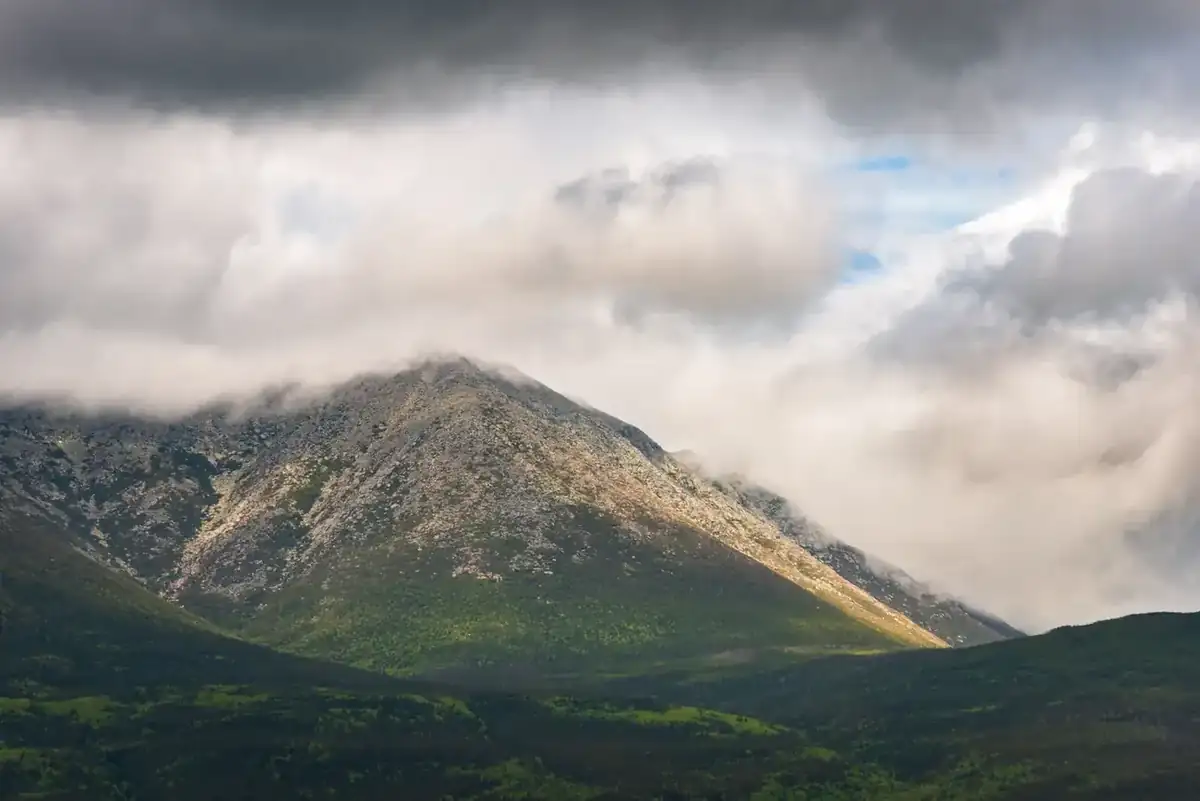
- Location
- Maine
- Current protection
- Baxter State Park, Katahdin Woods and Waters National Monument, Appalachian Trail
- Status
- Active citizen campaign
- In the book
- Featured in Undiscovered America
Why should it be a National Park?
There may be no area as undiscovered by tourists and nature enthusiasts as Maine's North Woods. This is the largest stretch of uninterrupted wilderness remaining in the eastern United States. While several conservation groups and public land advocates have been vocal about protecting northern Maine for decades, the first prominent person to espouse this desire was Henry David Thoreau, who traveled to the area in 1846, 1853, and 1857. He eventually published a book "The Maine Woods" in 1864 detailing these visits and why the region's wild nature was worth conserving in its natural state. Fortunately, much of the setting that Thoreau encountered remains. The population density remains less than one person per square mile.
The centerpiece of the North Woods region is Mount Katahdin, the tallest mountain in the state at 5,267 feet. The peak is also the northern terminus of the Appalachian Trail and located in Baxter State Park, which encompasses over 200,000 acres. Neighboring Katahdin Woods and Waters National Monument protects 87,000 acres of additional forests and waterways. Roxanne Quimby, the co-founder of the company Burt's Bees, and her son Lucas St. Clair, spearheaded the effort to establish the national monument in 2016 by donating their lands to the federal government. This donation was met with both loud support and skepticism.
New public lands almost universally receive negative feedback from the local community, but over time border communities come to love and honor their association with a nationally recognized landscape. Acadia National Park, also in Maine, was preserved as Sieur de Monts National Monument in 1916, under very similar circumstances. Wealthy conservationists, Charles W. Eliot and George B. Dorr, championed the idea of Acadia becoming the first National Park east of the Mississippi River. John D. Rockefeller Jr. then bought up additional lands so not only the rich, but everyone could enjoy Acadia's beauty. While the era of wealthy conservatism seems to be mostly over, Quimby's is still one family trying to live up to that standard.
Much of the controversy surrounding the new monument comes from the logging industry and hunters who do not want the productive and sportsman-friendly forests to become off-limits. The land donated by Quimby helps enlarge the protected area of the North Woods, but critics say that turning over the land to the government means the forests can no longer be logged and that will harm Maine's economy. This argument is disingenuous because before the donation, Quimby did not allow logging on her land. The change in ownership simply provides an additional layer of protection for a tract of land that would never have been logged in the first place. Katahdin Woods and Waters is instead an example of a way forward not only for the magnificent North Woods region but for the future of conservation in America.
Henry David Thoreau famously called for the protection of this region. While he may have been one of the first, he was not the last. Several campaigns, including the well-known 'RESTORE: The North Woods' have been focused on creating a National Park. The most recent attempt resulted in, not a National Park, but Katahdin Woods and Waters National Monument.
The history of National Park Campaigns
Maine's North Woods have hosted four distinct National Park debates: a 1911 federal bill and Burton Howe's 1920 Katahdin expedition "to determine its feasibility for the site of a National Park," which Percival Baxter redirected into a state park; Rep. Ralph Owen Brewster's 1937 Katahdin National Park bill (H.R. 6599), which Baxter fought; the 1950s–60s Allagash fight, which Maine settled with its own Wilderness Waterway (1966); and RESTORE: The North Woods' 3.2-million-acre Maine Woods National Park (1994–present), which produced Katahdin Woods and Waters National Monument (2016).
- Distinct National Park attempts
- 4 debates (1911/1920; 1937 H.R. 6599; 1994–present RESTORE; 2011–16 Elliotsville) — with the 1935 NPS report and 1963
- Allagash idea as federal studies
- Other designation attempts
- state park 1931–62; Allagash Waterway 1966; monument 2016
Sources
- Bates College honors thesis (2016) on Maine's four park debates
- Howard Whitcomb, Governor Baxter's Magnificent Obsession (2008)
- H.R. 6599 (75th Cong.) text and hearings
- Neil Rolde, The Interrupted Forest (2001)
- RESTORE archives
- 1895
Maine Proprietors Association urges a state park around Katahdin for tourism. (Wikipedia, Percival Baxter)
- 1911
"A bill was introduced to turn the region into a U.S. National Park but none of the plans came to fruition." VERIFY sponsor/number.
- 1916–1921
Baxter campaigns for a state park; 1919 legislature passes a substitute bill for a future donated-land park; 1920 — Burton W. Howe's expedition (Baxter, Charles P. Barnes; guide Roy Dudley) "to determine its feasibility for the site of a National Park"; January 1921 — Baxter's "Mt. Katahdin State Park" bill; spurned by the legislature. (Bowdoin; Baxter State Park history)
- 1931–1962
Baxter's 28 donations create Baxter State Park (200,000+ acres), "forever wild."
- 1935
National Park Service report on Katahdin's recreational potential. (Bowdoin, "A Magnificent Obsession")
- April 1937
H.R. 6599, Rep. Ralph Owen Brewster (R-ME), Katahdin National Park — would transfer the state-held Baxter lands to the federal government and authorize acquisition of surrounding lands; Baxter (Brewster's rival) opposed; the bill died. (Appalachian Trail Histories, "H.R. 6599")
- 1950s–1960s
Allagash: federal dam proposals (Rankin Rapids), NPS's Allagash national riverway idea (1963), Sen. Muskie; Maine preempts with the Allagash Wilderness Waterway (1966), the first state-administered river in the national W&S system (1970). VERIFY details.
- 1992–1994
RESTORE: The North Woods founded (Michael Kellett, Jym St. Pierre); 1994 — 3.2-million-acre Maine Woods National Park & Preserve proposal; "No Maine congressional delegation or Governor has ever supported the idea." (House Natural Resources testimony, Trahan)
- 2011–2016
Elliotsville Plantation (Roxanne Quimby/Lucas St. Clair) offers ~87,500 acres; August 24, 2016 — Proclamation 9476, Katahdin Woods and Waters National Monument.
- 2026
Monument management-plan public comment; redesignation to National Park not formally proposed. (2026 inventory)