- Location
- Texas
- Current protection
- Big Thicket National Preserve, Caddo Lake, Martin Dies Jr. State Park
- Status
- No active campaign
- In the book
- Featured in Undiscovered America
Why should it be a National Park?
The Piney Woods ecoregion is made up of temperate coniferous forest and wetlands covering roughly 55,000-square-miles of eastern Texas, southwestern Arkansas, and northwestern Louisiana. The overlap of ecosystems and ecological influences here enables a large diversity of species to coexist within a relatively small area. There are few places on earth where you can walk through a beech-magnolia-loblolly pine woodland and then see roadrunners darting between longleaf pines and cactus.
The American south, especially the Piney Woods region, became a melting pot for plants and animals escaping the last ice age that covered most of the northern states. Several biomes that were once separated by great distances merged here and many still survive leading this area to be described as the "biological crossroads of North America" or the "American Ark".
Despite the biodiversity located here, no major protections have been put in place to ensure the woods are preserved as a natural laboratory for flora and fauna. Besides its biodiversity, there is also a wealth of prehistoric megafauna including mammoths, giant armadillos (glyptodons), and others that endured the ice age and left behind dying out and leaving behind only their skeletons.
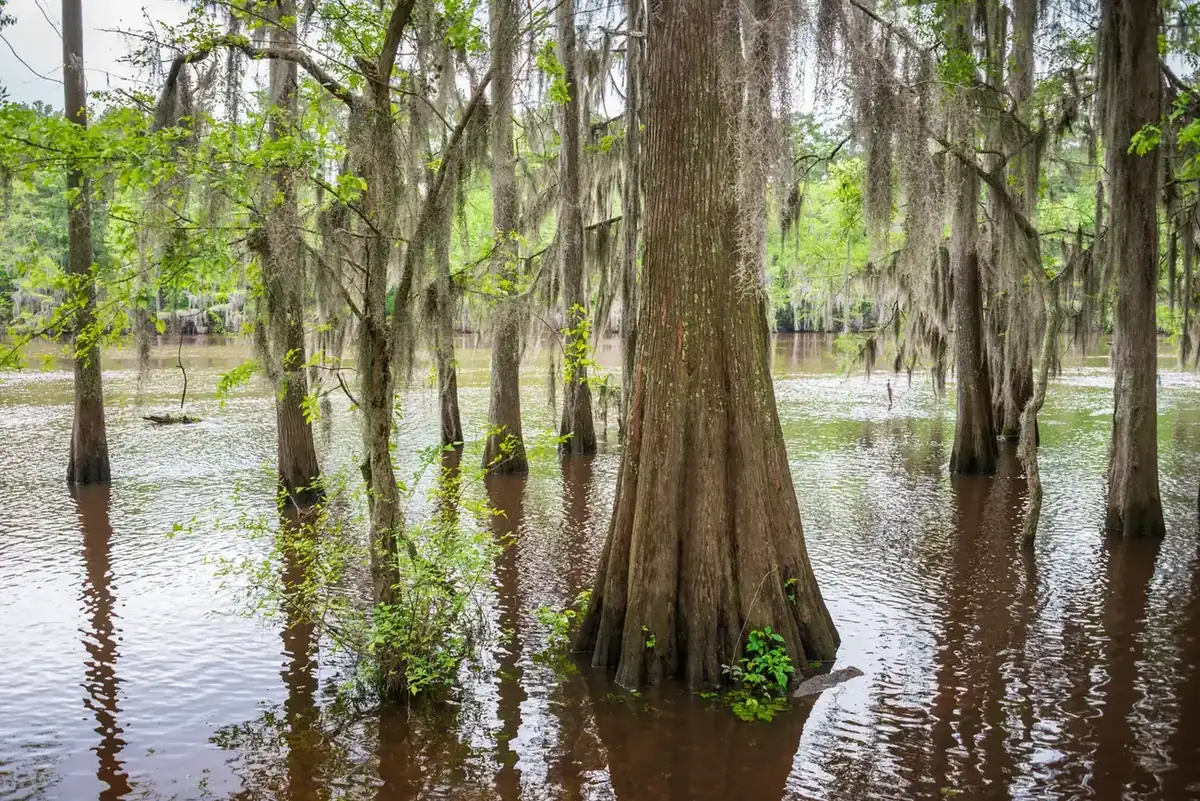
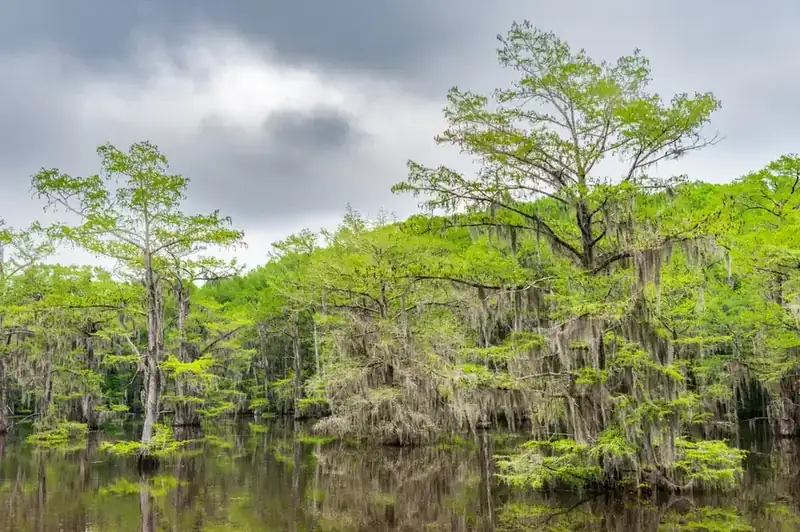
The dominant trees in this region are the bald cypress and water tupelo. In sloughs and slow-moving water, water tupelo usually occupy the deeper parts and bald cypress the margins and more shallow parts. These tree species extend the thick forests into the many lakes and bayous that span the region. Cypress knees, parts of the tree that stick up out of the water, vary in height from a few inches to over 12 feet tall. Research has found no physiological function for cypress knees, but they are a defining feature of the ecosystem.
Amongst the dozens of state parks and federal reserves that dot the region, the Big Thicket National Preserve, named for a specific landscape within the larger Piney Woods environment, is one of the most biodiverse areas in the world. Established in 1974, the Big Thicket National Preserve was the first preserve within the National Park Service. The 'preserve' designation was created in an attempt to protect the ecoregion, while also avoiding the controversy that comes with a national nark designation. Preserves seek to avoid this controversy by allowing fishing, hunting, mining, and resource extraction, and this model has led to a total of 19 preserves within the National Park Service.
The series of state and federal parks are better than no protection at all, but most of these parks are focused on public access and altering the landscape for tourists rather than preserving the natural setting or biodiversity. The spotty conservation of the Piney Woods and the swelling population of Texas is slowly destroying the viability for it to remain a center of biodiversity.
The history of National Park Campaigns
The Big Thicket is the longest sustained park campaign in this batch, running from R.E. Jackson's 1927 East Texas Big Thicket Association through a Depression-era 435,000-acre park proposal, a mid-century dormancy, a 1960s revival led by the Big Thicket Association and Sen. Ralph Yarborough, and a marathon of ~30 competing bills before Congress resolved the fight in 1974 by inventing a new category — the national preserve — to allow continued hunting. It was one of the two first national preserves in the system.
- Distinct National Park attempts
- 2 eras (1936–1941; 1966–1974, comprising ~a dozen distinct park bills)
- Other designation attempts
- 3+ (NPS 1967 monument proposal; 1974 preserve; 1993 addition; plus state-park efforts and Caddo Lake NWR)
Sources
- TSHA Handbook of Texas, "Big Thicket"
- Sierra Club Lone Star Chapter (Houston) history series (2023)
- George Bush School capstone, "Big Thicket" (2020)
- bigthicket.org/about
- P.L. 93-439 and P.L. 103-46 (govinfo.gov)
- NPS RG 79 Big Thicket study files
- Yarborough Papers (UT Austin)
- Pete A.Y. Gunter, The Big Thicket: An Ecological Reevaluation (1993)
- 1927
R.E. Jackson founds the East Texas Big Thicket Association to win a National Park. (Secondary: TSHA Handbook of Texas.)
- c. 1936–1941
Jackson's association promotes a 435,000-acre Big Thicket National Park; NPS reconnaissance interest. Stalled by wartime timber demand and timber-industry opposition. Sierra Club Houston history: "The largest proposal was for a Big Thicket National Park that would have been 435,000 acres." (UNVERIFIED on the exact NPS study author/date — likely tied to Roland Harper's botanical surveys.)
- 1940s–1950s
Dormancy.
- October 4, 1964
Dempsie Henley (mayor of Liberty) and naturalist Lance Rosier found what becomes the Big Thicket Association (articles of incorporation filed Nov. 19, 1964). By 1966 it commits to national-park status. (bigthicket.org; Sierra Club.)
- 1962–1965
State-level activity: Texas Parks and Wildlife Commission (1966) recommends a Big Thicket State Park; the Legislature never funds it. A commission proposed 52,300 acres at six sites — origin of the "string of pearls" concept.
- October 20, 1966
Sen. Ralph Yarborough (D-TX) introduces S. 3929, a 75,000-acre Big Thicket National Park (Hardin, Liberty, San Jacinto, Polk, Tyler counties). Referred to committee, where it languished nearly five years. Biologist Claude McLeod (Sam Houston State) mapped 1.5 million acres as the basis for the NPS report.
- January 11, 1967
Yarborough reintroduces as S. 4; Rep. Jim Wright (D-TX) introduces companion H.R. 11188 (June 27, 1967). NPS recommends a 35,000-acre "string of pearls" National Monument — hailed by timber companies who kept cutting rights. Yarborough called it "timid."
- 1970
Yarborough's bill passes the Senate only; Rep. Bob Eckhardt (D-TX) introduces a 191,000-acre park bill endorsed by the Big Thicket Coordinating Committee. Rep. John Dowdy had earlier pushed a competing ~35,000-acre bill.
- 1971
Sen. Lloyd Bentsen (D-TX), having defeated Yarborough in the 1970 primary, introduces a 100,000-acre park bill; both Bentsen and 1970 opponent George H.W. Bush had endorsed a park.
- 1970–1972
Numerous bills by Reps. Jack Brooks, George Bush, Jim Wright, Alan Steelman, and Sen. John Tower; ~27 Big Thicket bills total, pro and con.
- 1973–1974
Rep. Charles Wilson (D-TX) brokers the compromise, introducing H.R. 11546 (84,550 acres). Senate passes Oct. 1, 1974 (Bentsen/Tower agree to the compromise).
- October 11, 1974
President Ford signs P.L. 93-439, establishing the 84,550-acre Big Thicket National Preserve — which, together with Big Cypress National Preserve (Florida), established the same day, became the first two national preserves in the National Park System. Why "preserve" not "park": the new category permitted regulated hunting, defusing sportsmen's opposition, and matched NPS findings that the fragmented Thicket lacked the contiguous wilderness for park standards.
- 1986
Rep. Wilson introduces a Big Thicket Addition Act; Sen. Phil Gramm demands exclusion of private dwellings.
- 1993
Big Thicket Addition Act (P.L. 103-46) authorizes 10,766 additional acres.
Caddo Lake (related): Caddo Lake State Park (1934); the 1990s effort converting part of the Longhorn Army Ammunition Plant to Caddo Lake National Wildlife Refuge (2000), aided by Don Henley's Caddo Lake Institute; Ramsar wetland designation (1993). No National Park/monument proposal for Caddo Lake was found. UNVERIFIED whether any "Piney Woods National Park" (as a distinct name) was ever formally proposed.
- 2024
Preserve celebrated its 50th anniversary.