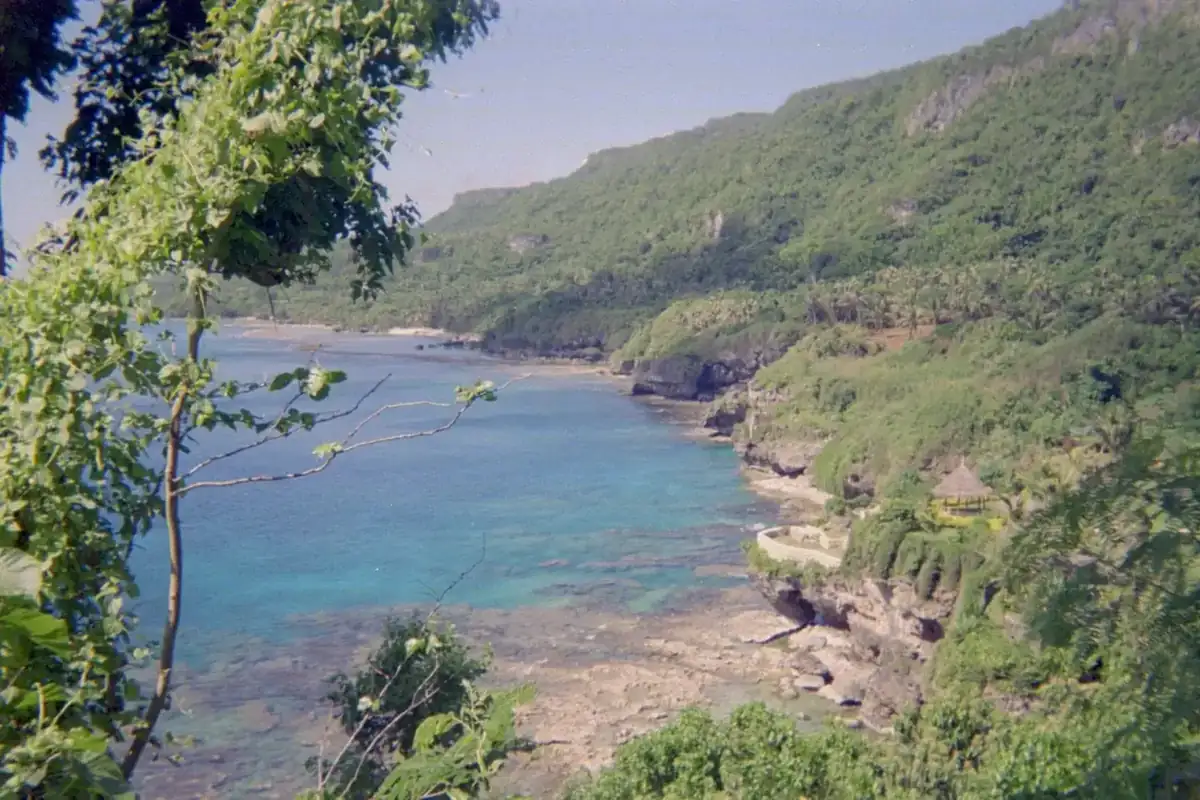
- Location
- Northern Mariana Islands
- Current protection
- Rota latte stone quarry (As Nieves), Wedding Cake Mountain, Sabana plateau
- Status
- Study completed in 2023; no park recommended
- In the book
- Not featured in Undiscovered America
Why should it be a National Park?
Rota is the southernmost of the Northern Mariana Islands, thirty-three square miles of raised limestone in the western Pacific, and it is the only substantially inhabited island in the Marianas that was not fought over in the Second World War. American forces bypassed it. Saipan and Tinian were shelled, bombed, bulldozed, and rebuilt; Rota was left alone. The result is an island where the ancient Chamorro landscape survived largely intact, and archaeologists describe its prehistoric sites as the most numerous and best preserved in the entire archipelago.
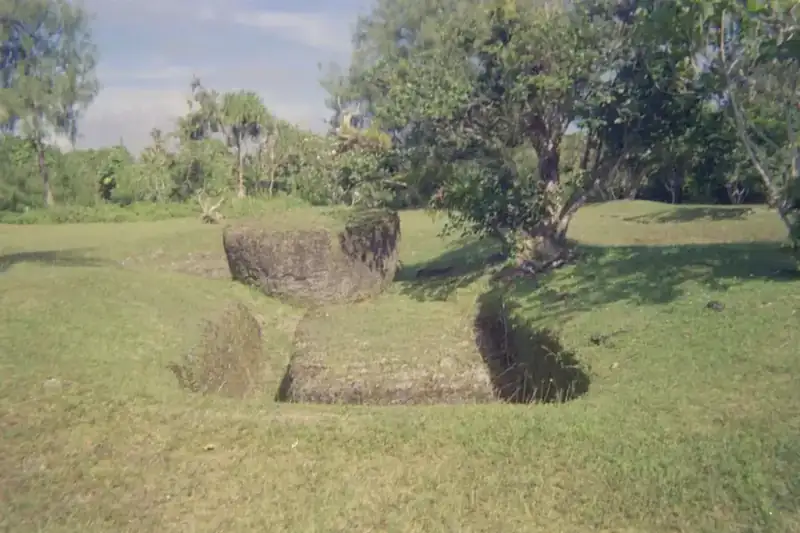
The signature of that culture is the latte: paired rows of stone pillars capped with hemispherical stones, the foundations of Chamorro houses. At the As Nieves quarry on Rota, latte stones lie where they were being cut out of the bedrock when work stopped, and they are the largest in the Marianas. Four prehistoric sites here are on the National Register, including the Monchon latte village and the Chugai cave with its Chamorro rock art. The Japanese administration from 1914 to 1945 left its own layer, including a sugar mill that is on the register too.
The forest matters as much as the ruins. Rota holds the best remaining native limestone forest in the Marianas, tall-canopy and closed, and it is the last home of the Mariana crow, the åga, which is down to a population measured in the dozens, and of the Rota bridled white-eye, which lives nowhere else on earth. Two endangered plant species are found only here.
The Park Service assessed Rota in 2005 and concluded that a National Park unit appeared to be the best way to protect its resources. Delegate Kilili Sablan filed study bills; the House passed one under suspension in 2010 without objection, and the study was finally authorized in 2014 and funded in 2016. The finished study went to Congress in October 2023, and its conclusion was that Rota's resources are nationally significant and suitable, but that Park Service management is not needed to protect them. After nearly twenty years, the answer was that the island deserves a National Park and does not require one.
Nothing about the island is set up for visitors, which is both the charm and the problem. There is one small airport, a handful of hotels in Songsong, and a road that loops the island past the Japanese sugar mill left rusting where it stood in 1944. The war went around Rota rather than through it. The garrison was bypassed and starved out instead of assaulted, which is the reason the forest and the ruins survived intact when Saipan and Tinian were fought over acre by acre.
The Mariana crow is the clearest stake. The bird is gone from Guam, eaten out by the introduced brown tree snake, and Rota holds the last wild population on earth, in the tens of individuals. If the snake reaches Rota, the species ends. That single fact turns an argument about designation into an argument about biosecurity and inspection money.
What Rota needs is the arrangement, not the argument. Land on the island is held under Commonwealth law with protections for Chamorro and Carolinian owners, and the Park Service has worked inside exactly that kind of constraint before, at Canyon de Chelly and across the American Memorial Park in Saipan. The 2005 assessment already said a park unit looked like the best tool available. Twenty years later the latte quarry, the limestone forest, and the last of the Mariana crows are still waiting for the country to treat them as the first-rank places they are.
The history of National Park Campaigns
Delegate Gregorio Kilili Camacho Sablan secured a special resource study of Rota through the FY2015 National Defense Authorization Act, funded in FY2016. The NPS transmitted the study to Congress on October 5, 2023, finding the island's prehistoric, historic, and limestone-forest resources nationally significant and suitable, but concluding that NPS management is not needed and that Rota therefore does not meet all criteria for a new park unit.
- Distinct National Park attempts
- 1 (study 2014–2023)
- Other designation attempts
- 0
Sources
- NPS Rota Special Resource Study (2023), parkplanning.nps.gov
- P.L. 113-291, Title XXX, Section 3051
- Saipan Tribune coverage, 2023
- 2009
Rota Sen. Songao proposes National Park status through Delegate Sablan.
- 2013
H.R. 674 (113th Congress) proposes a special resource study.
- December 19, 2014
The study is authorized in the FY2015 NDAA (P.L. 113-291, Title XXX, Section 3051).
- 2015
Funded through P.L. 114-113.
- October 5, 2023
The NPS transmits the Rota Special Resource Study, finding the resources nationally significant and suitable but that NPS management is not needed; feasibility is conditional on CNMI support and funding.