- Location
- South Dakota
- Current protection
- Custer State Park, Mount Rushmore National Memorial, Wind Cave National Park
- Status
- No active campaign
- In the book
- Featured in Undiscovered America
Why should it be a National Park?
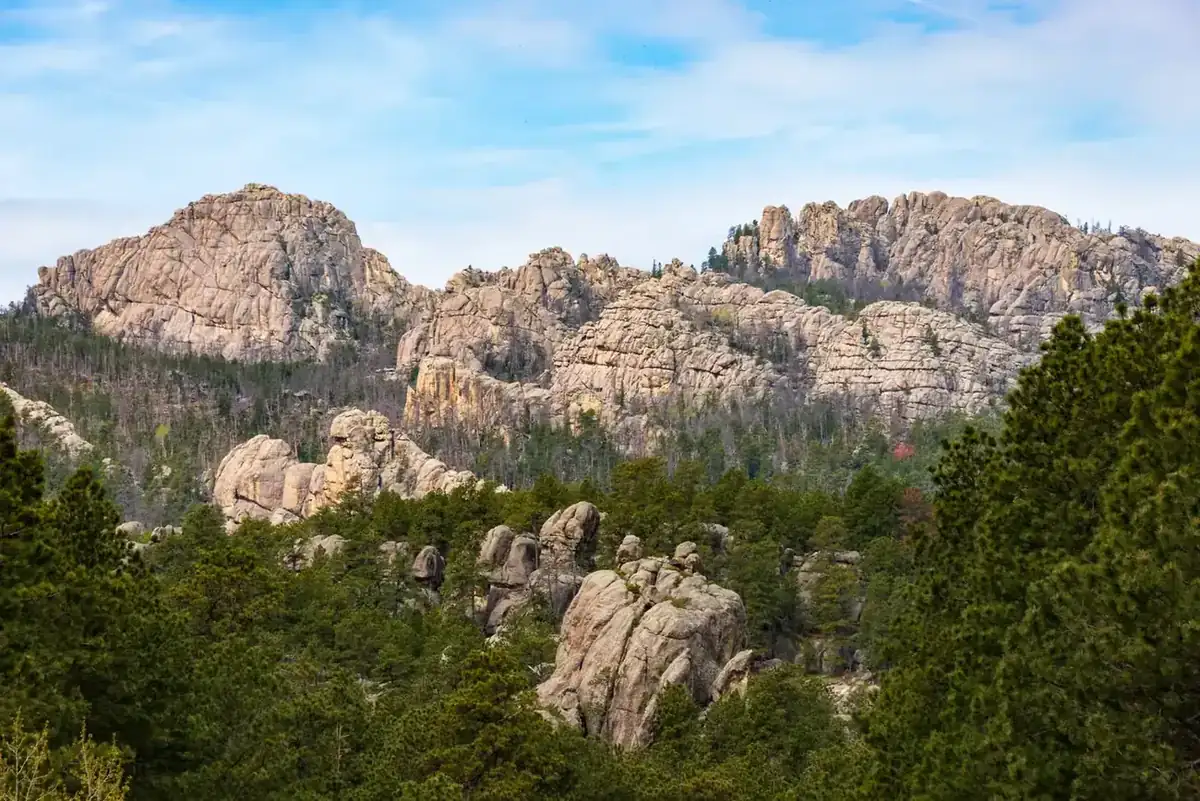
The Black Hills in South Dakota are a mountain range unlike any other, encompassing an area of 145 miles long and 65 miles wide that towers over the surrounding great plains. The name Black Hills comes from the ominous color the mountains exhibit when seen in shade. While beautiful in the light, when backlit, the grey stone and dense pine trees give the appearance of a dark wall rising above the horizon. Approaching from the east coast, the Black Hills are the first prominent natural site to appear on the horizon after passing beyond the Appalachian Mountains. Harney Peak, the highest point in the mountain range, is more than 500 feet higher in elevation than any mountain found in the eastern United States.
The Black Hills are made up of four interconnected landscapes: large grassy plains which provide a home and food to herds of wildlife, thick ponderosa pine forests that rise on the surrounding hills, massive granite rock faces, and intricate underground cave systems. Collectively the lands are managed by the NPS, USFS, and South Dakota state park system, with native tribes and private land inholdings filling out the spaces in-between.
The traditional prairie environment, found in and around the hills, has created an island of diversity for animals such as bison, pronghorn, bighorn sheep, mountain lions, prairie dogs, flying squirrels, and marmots who used to live on the open range. Due to habitat loss, the Black Hills have become a refuge for these animals. In order to continue to protect and ensure the survival of these species, the range needs to be made into a protected environment.
Geologically, the Black Hills exhibit an array of unique and distinct features. The most recognizable and famous site in the hills is Mount Rushmore, which itself is carved from the granite boulders and spires that cover the range. Additionally, the hills contain a number of caves, most famously Jewel Cave (named for its decorative crystals) and Wind Cave (a small National Park featuring the rare boxwork and frostwork formations).
In addition to the geology and wildlife, which make the environment distinctive, the Black Hills also have a complicated and fascinating human history. For thousands of years Plains Indians such as the Sioux have lived in and around the mountains. The arrival of homesteaders devastated the native way of life as settlers began homesteading and mining in the region. This invasion of tribal lands culminated in the Great Sioux War of 1876 (also known as the Black Hills War.) Several battlefields from this period dot the region, including nearby Little Bighorn and Wounded Knee.
Many people believe the Black Hills are already a National Park, but sadly this is a mistaken assumption. While each of the currently protected sections of the range highlight one unique aspect of the mountains, this patchwork does the overall range an injustice.
The history of National Park Campaigns
The Black Hills were carved into protective units early — Forest Reserve (1897), Wind Cave NP (1903), Jewel Cave NM (1908), Custer State Park (Peter Norbeck's creation, 1919), the Custer State Park Game Sanctuary/Norbeck Organic Act (1920; renamed Norbeck Wildlife Preserve 1949), and Mount Rushmore (1925–41). Rather than a single "Black Hills National Park," Norbeck built a state-park empire; no federal "Black Hills National Park" or "Harney National Park" bill was ever introduced. The most significant "park"-style proposals of the modern era are the Lakota land-return bills (Bill Bradley's Sioux Nation Black Hills Act, 1985/1987) — which would have created a "Sioux Park" from existing NPS lands — plus a 2012 "Sioux National Park" version, and Gov. Daugaard's 2016 Spearfish Canyon State Park land-exchange effort.
- Distinct National Park attempts
- Distinct National Park attempts (as such): 0 for a conventional "Black Hills National Park"; 3 for the "Sioux Park"/"Sioux National Park" land-return proposals (1985, 1987, 2012) if counted as national-park-style units
- Other designation attempts
- many (Wind Cave 1903, Jewel Cave 1908, Custer State Forest/Park, game sanctuary 1920, Norbeck Preserve 1949, Spearfish Canyon 2016)
Sources
- Gilbert Fite, Peter Norbeck: Prairie Statesman (1948)
- South Dakota Magazine Norbeck features
- congress.gov S.1453 (99th), S.705 (100th), S.3254 (114th)
- Edward Lazarus, Black Hills/White Justice (1991)
- U.S. v. Sioux Nation of Indians, 448 U.S. 371 (1980)
- 1897
Black Hills Forest Reserve.
- 1903
Wind Cave National Park established (grew from cave protection, not a larger Black Hills park scheme).
- 1908
Jewel Cave National Monument.
- 1912
Custer State Forest; 1919 — Custer State Park (Norbeck, as governor, created a state park board).
- c. 1919–1920
Custer State Park expansion via federal transfer. Norbeck had Rep. Harry Gandy (D-SD) introduce a bill in Congress to transfer the Sylvan Lake/Needles/Harney Peak area from the Harney National Forest to state control, nearly doubling the park to over 70,000 acres. Source: South Dakota Magazine, "Norbeck's Home In Need."
- June 5, 1920
Norbeck Organic Act; President Wilson established the Custer State Park Game Sanctuary (Oct. 9, 1920) from 30,000 acres of the Harney National Forest (16 U.S.C. §675).
- 1925–1941
Mount Rushmore carved (Norbeck a key legislative backer).
- 1949
Norbeck Wildlife Preserve (federal portion of the game sanctuary renamed to honor Norbeck, who died in 1936).
- June 30, 1980
United States v. Sioux Nation of Indians, 448 U.S. 371. The Supreme Court affirmed an award of $17.1 million (the 1877 fair market value of the Black Hills) plus roughly $88 million in accrued 5% simple interest from 1877 — about $105 million total — holding that "a more ripe and rank case of dishonorable dealings will never, in all probability, be found in our history." The Lakota refused the money, demanding land return; the award has since grown to over $1 billion in trust, still unclaimed.
- July 17, 1985
S. 1453 (99th Cong.), Sioux Nation Black Hills Act, Sen. Bill Bradley (D-NJ). Drafted by the Black Hills Steering Committee (coordinated by Gerald Clifford); would reconvey ~1.3–1.6 million acres of federal land, establish a "Sioux Park" from lands previously under NPS jurisdiction and a "Black Hills Sioux Forest," while prohibiting conveyance of the Mount Rushmore National Memorial. Senate Committee on Indian Affairs held hearings July 16, 1986; the bill died. Sources: congress.gov S.1453; Bradley bill text (indianz.com). Opposition came from Black Hills residents (historian David B. Miller argued it jeopardized their autonomy) and from Sens. Larry Pressler and Tom Daschle's non-support.
- March 10, 1987
S. 705 (100th Cong.), Bradley reintroduction. Internal Lakota disputes (Phil Stevens's alternative demanding ~$3.1 billion plus far larger acreage) fractured support; Bradley held back and the momentum was lost. Sources: govtrack; indianz.com. Bradley: "When there is a semblance of unity between the different factions of the Sioux people, perhaps another Bill can be introduced."
- 2009 & 2012
later revivals: a "Sioux Nation Black Hills Act" (2009, over 1 million acres) and a "Black Hills Sioux Nation Land Return Act" (2012, expressly proposing a "Sioux National Park"); neither passed. Source: EBSCO research starter "Black Hills tribes."
- Jan. 2016
Gov. Dennis Daugaard's Spearfish Canyon State Park proposal; July 14, 2016 — S. 3254 (114th Cong.), Spearfish Canyon and Bismarck Lake Land Exchange Act, Sen. John Thune (R-SD) (cosponsor Sen. Rounds; House companion by Rep. Kristi Noem). It would swap ~1,954 acres of state land for 1,468 acres (Spearfish Canyon) + 524 acres (Bismarck Lake) of Black Hills NF to create a ~1,400-acre state park. Senate Energy & Natural Resources hearing Sept. 22, 2016; the Forest Service (Deputy Chief Leslie Weldon) opposed it as "unnecessary and contains provisions that raise concerns." The enabling state land-exchange funding failed in the 2017 SD legislative session, ending the effort; the state continued a Spearfish Canyon master-planning process. Sources: govtrack/govinfo S.3254; Rapid City Journal; SDPB.