- Location
- Virginia/North Carolina
- Current protection
- Blue Ridge Parkway, Mount Mitchell State Park, Graveyard Fields
- Status
- No active campaign
- In the book
- Featured in Undiscovered America
Why should it be a National Park?
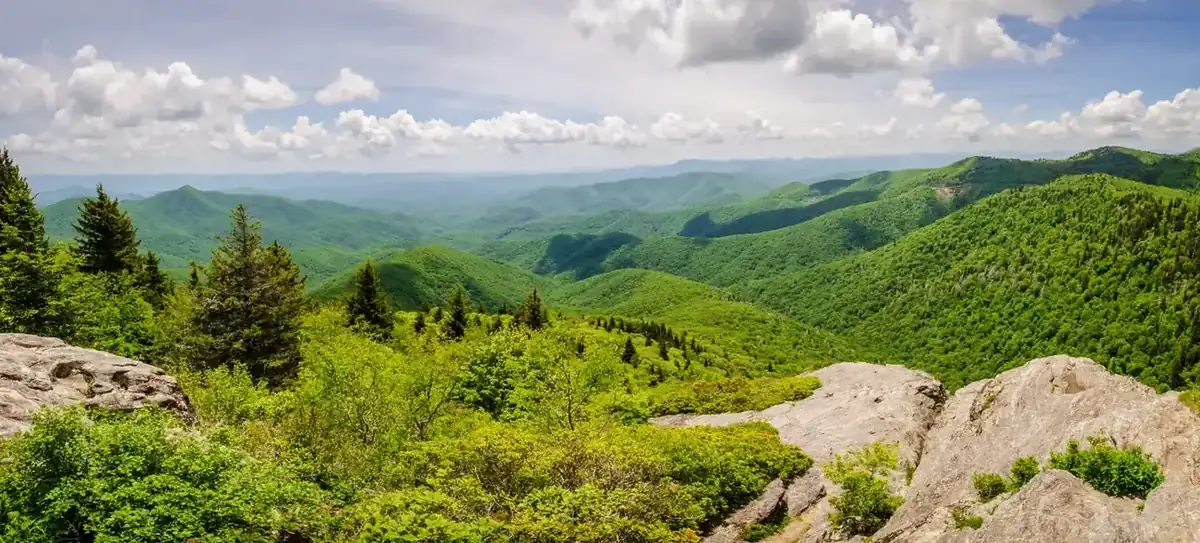
The best National Park east of the Mississippi River isn't even a 'National Park', it's the Blue Ridge Parkway which spans a significant portion of Virginia and North Carolina. The parkway begins at the southern boundary of Shenandoah National Park and extends 469 miles along the crest of the Blue Ridge Mountains to the eastern entrance of Great Smoky Mountains National Park.
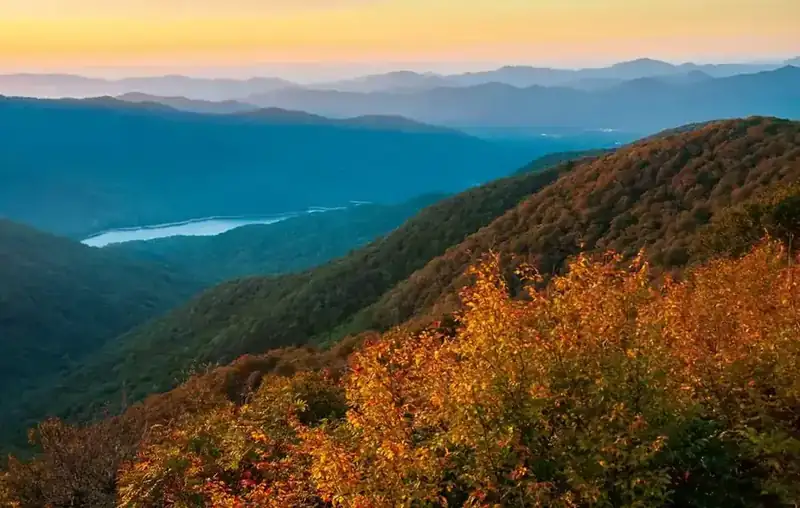
This beloved route showcases stunning long-range vistas and close-up views of the rugged mountains and pastoral landscapes of the Appalachian Mountain range.
In addition to natural beauty, the parkway also features the complex history of the people who make up Appalachia. Hundreds of historic structures including cabins, farmsteads, barns, mills, hotels, museums, and performance spaces give visitors a glimpse into the lifestyles and culture of the men and women who populated this rustic environment.
The parkway is designed for slow-paced travel, 45 mph or less — a travel experience free from the commercial traffic and congestion of high-speed highways. Tourists can easily pick sections of the route to visit as a day trip, or they can choose to travel the entire length of the parkway over several days. Campgrounds and lodges are spread throughout the drive. Additional lodging is also available in small towns along the way, but may require descending from the parkways to the base of the mountains.
The Blue Ridge Parkway is so popular it receives 14.9 visitors annually. Only Golden Gate National Recreation Area, which is located in and around San Francisco, receives more visitors per year. The scale of the landscape makes this NPS site a missed opportunity. Nothing about the grandeur, historical significance, or natural beauty found here suggests this site isn't deserving of being redesignated as a National Park. In fact, all the things that make the parkway great also make it an outlier.
The National Park Service protects 10 National Parkways, eight of which are between 2 and 31 miles in length. The other two, the Blue Ridge and Natchez Trace parkways, are entirely different at well over 400 miles each. The best preserved aspect of the Natchez Trace is the path itself, which is a historically important route between Nashville, Tennessee, to Natchez, Mississippi. Alternatively, the Blue Ridge Parkway's central features are the Blue Ridge Mountains and the history of the people who live here. Because of this, the Blue Ridge Parkway has more in common with a National Park than a parkway, and it may be time to change its designation to reflect this.
The history of National Park Campaigns
The Southern Appalachian park movement began in Asheville in 1899 with the Appalachian National Park Association; the resulting 1901–02 federal study (Senate Doc. 84) pointed toward what became national forests (Weeks Act 1911; Pisgah NF 1916) rather than a National Park, while the park impulse later flowed into Great Smoky Mountains NP (1934) and Shenandoah. Mount Mitchell became NC's first state park (1915). A late-1970s effort to make Mount Mitchell a National Park was studied and dropped in 1979 amid local opposition [Round 7 correction: no bill "passed Congress"; NCpedia overstates]. The Blue Ridge Parkway (authorized 1936) and the Blue Ridge National Heritage Area (2003) are the region's other major federal designations.
- Distinct National Park attempts
- Distinct National Park attempts touching this region: ~2–3 — (1) the 1899–1905 Appalachian National Park movement (which named Grandfather Mountain and the Blue Ridge in its study boundaries); (2) the late-1970s Mount Mitchell national-park proposal (dropped 1979); with the Great Smokies as the movement's ultimate redirect
- Other designation attempts
- many (state park 1915, national forests 1911/1916, Parkway 1936, NHA 2003, Grandfather SP 2009)
Sources
- Senate Doc. 84 (1902)
- Appalachian National Park Association General Records 1899–1936 (NC Western Regional Archives, Org.19)
- A. Chase Ambler book collection (Appalachian State)
- Margaret Lynn Brown, The Wild East: A Biography of the Great Smoky Mountains (2000)
- Anne Mitchell Whisnant, Super-Scenic Motorway: A Blue Ridge Parkway History (2006)
- NCpedia
- 1885
earliest advocacy. Rev. Drayton Canario Smith (Franklin, NC) and Dr. Henry O. Marcy (Boston, who read a paper to the American Academy of Medicine on Oct. 29, 1885) each urged a Southern Appalachian national reservation. Source: A. Chase Ambler book collection, Appalachian State University.
- March 6, 1899
Good Roads Association of Asheville organized; Oct. 7, 1899 — Asheville Board of Trade adopted a petition calling for a "Southern National Park."
- Nov. 22–23, 1899
Appalachian National Park Association organized at the old Battery Park Hotel, Asheville. Per the NC Archives finding aid (Org.19): the meeting "drew a large attendance from seven southeastern states... George S. Powell was the association's first president," with Dr. Chase P. Ambler as secretary. The impetus came from an 1899 fishing trip by former Secretary of State William R. Day and Ambler.
- Dec. 19, 1899
Memorial to Congress adopted (the first petition to create an eastern National Park); presented Jan. 2, 1900, and referred to the Committee on Agriculture.
- Summer 1900
federal survey by the Bureau of Forestry with the Geological Survey of ~9,600,000 acres of forest land.
- 1901–1902
Senate Document 84, "Message from the President... A Report of the Secretary of Agriculture in Relation to the Forests, Rivers, and Mountains of the Southern Appalachian Region." Its boundaries expressly named Grandfather Mountain (5,964 ft) among the region "in which it is proposed to make a National Park," covering ~12,000 sq mi mainly in NC (with parts of SC, GA, TN, VA). Source: npshistory.com sen-doc-84.
- 1905
Association disbands; the movement pivots to forest reserves.
- 1911
Weeks Act; 1916 — Pisgah National Forest established — the forest (not park) outcome.
- March 3 / March 13, 1915
Mount Mitchell State Park established (Gov. Locke Craig, in response to logging that was "destroying a well-known landmark"), NC's first state park, in the same bill that created the NC State Parks System.
- 1934
Great Smoky Mountains National Park established (the movement's ultimate fruit).
- June 30, 1936
Blue Ridge Parkway authorized (originating in the 1933–34 "Appalachian Scenic Highway"/Skyline Drive concept).
- 1952
John D. Rockefeller Jr. gift funding the Linville Falls / Linville Gorge additions to the Parkway.
- Late 1970s
Mount Mitchell National Park effort (NP attempt). NCpedia: "In the 1970s legislation proposing to make Mount Mitchell a National Park was passed by Congress; however, there was considerable local opposition and the idea was dropped in 1979." Round 7 CORRECTION: no Mount Mitchell National Park bill passed Congress; P.L. 95-625 (1978) contains no Mount Mitchell provision. Say "proposed/studied and dropped in 1979" amid Yancey County opposition. Sources: ncpedia.org/mount-mitchell; northcarolinahistory.org.
- 2003
Blue Ridge National Heritage Area designated (25 WNC counties, including Mount Mitchell in Pisgah NF and the Qualla Boundary).
- 2009
Grandfather Mountain State Park established (no prior federal national-park bill for Grandfather was located, though it fell within the 1902 Senate Doc. 84 study area).