- Location
- Iowa/Wisconsin/Minnesota
- Current protection
- Effigy Mounds National Monument, Wyalusing State Park, Wildcat Mountain State Park/Kickapoo Valley
- Status
- Dormant campaign
- In the book
- Featured in Undiscovered America
Why should it be a National Park?
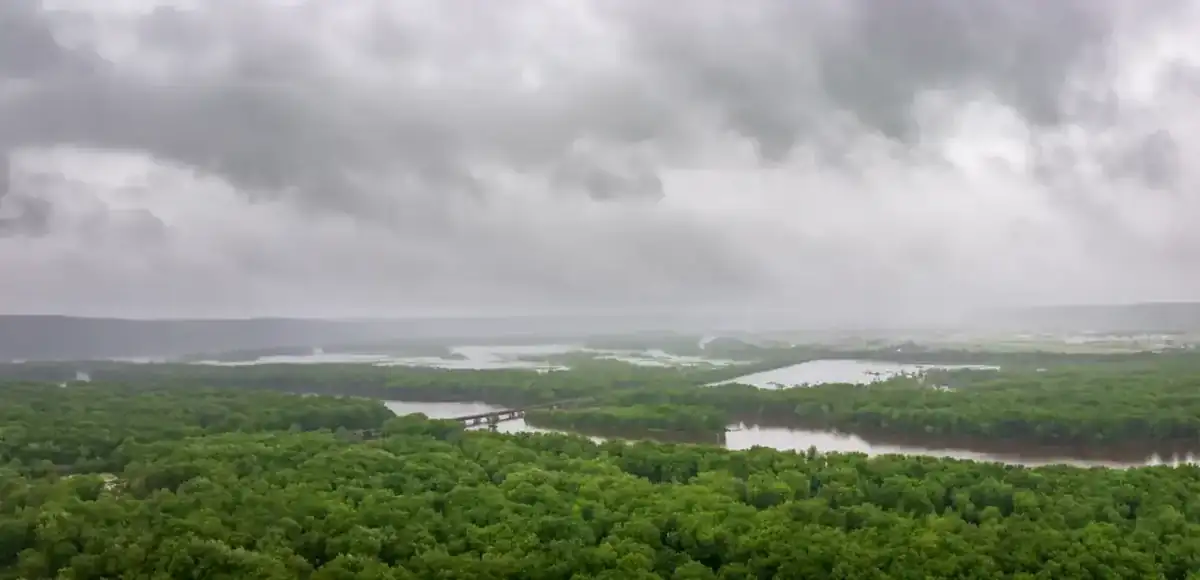
Unless you are from the sections of Minnesota, Wisconsin, Iowa, or Illinois that border the Mississippi River it's very unlikely you have ever heard the term "driftless" before. Much of the land that makes up the north-central region of the United States has been famously crushed flat by glaciers, but the Driftless Area is a notable exception.
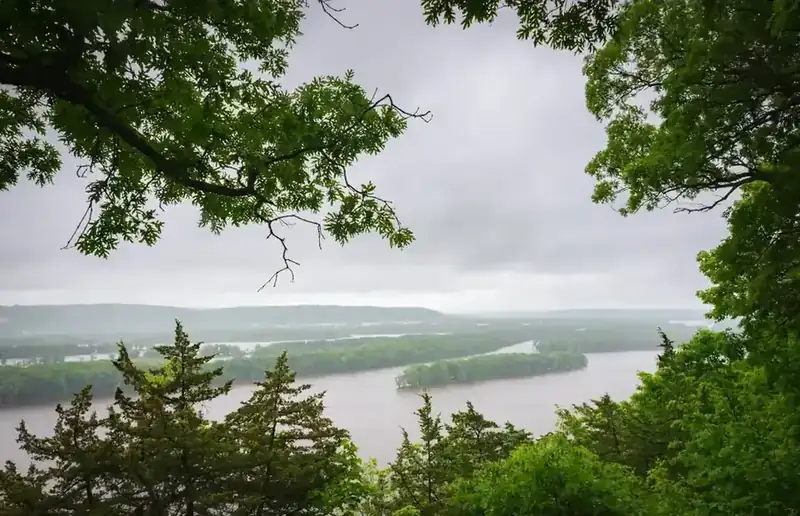
The region consists of hills, cliffs, valleys, and plateaus that the glaciers managed to skip over Today these rare hills rise above the encompassing plains as a monument to what the landscape was like before the last ice-age. Several rivers and creeks carried the waters of the melting glaciers through the hills and carved lowlands. This shifting terrain creates a network of waterways that all eventually empty into the mighty Mississippi River.
Currently, no area designated a National Park highlights the Mississippi River, one of the nation's most defining natural features. The closest comparable areas along the river are two sites that subvert the natural landscape rather than protect it.
The first is Gateway Arch National Park in Missouri, but it's better known as the St. Louis Arch. This curved metal memorial to westward expansion was renamed from Jefferson National Expansion Memorial in 2018 to draw in tourists, but while residing along the western banks of the Mississippi River the park fails to focus on the natural asset at its border.
The second is the Mississippi National River and Recreation Area. This area is contained entirely within Minnesota and is a "partnership park," where the majority of the lands and sites contained within its boundaries are not owned or controlled by the federal government, but by a series of private interests. Therefore, the central focus is on man-made structures rather than the natural setting.
While the Mississippi River is a major element of the Driftless Area, it is not the only feature that makes the region special. Scattered throughout the area are state and federal parks focusing on this unique setting and history. Greatest among them is Effigy Mounds National Monument, which showcases not only the extremes of the natural environment with its cliffs and expansive views above the river, but also the amazing Native American earthwork constructions in the shapes of animals and other symbols.
A local campaign is currently underway by the Driftless Rivers National Park Foundation to bring attention to this geologically significant location and hopes for the "creation of a new National Park in the ruggedly beautiful blufflands of the Upper Mississippi–the heart of America."
The Driftless Rivers National Park Foundation is actively seeking the creation of a new National Park in these ruggedly beautiful blufflands of the Upper Mississippi River.
The history of National Park Campaigns
This is the surprise of the round: the Upper Mississippi blufflands were the subject of a thirty-year National Park campaign (1901–1932) with a string of congressional bills, an NPS inspection, and a Roger Toll survey that finally killed the park idea and steered Iowa toward Effigy Mounds National Monument (1949). The Driftless Rivers National Park Foundation (2013) is the modern heir to a "Mississippi Valley National Park" idea that predates the National Park Service.
- Distinct National Park attempts
- Distinct National Park campaigns: 3 — (1) 1915–1923 Kenyon/Haugen bills (at least 3 sessions of bills); (2) 1929–1932 Haugen four-state proposal ended by the Toll survey; (3) 2013–present
- Driftless
- Rivers foundation
- Other designation attempts
- refuge 1924; monument 1936–49; parkway 1946; refuge 1989; Kickapoo Valley Reserve 1996–2000
Sources
- NPS, Effigy Mounds: Figures on the Landscape — Historic Resource Study (2003), ch. 8 and endnotes 145–169 (which cite the Kenyon/Haugen bills, Dorr's 1917 report, Haugen's 1929 proposal, and Toll's 1932 report to Albright)
- Roger Toll, report on the proposed Upper Mississippi National Park (1932, NPS/NARA)
- Iowa Conservation Commission records
- Congressional Record indexes 1915–1923 (bill numbers to pull)
- Will Dilg / Izaak Walton League histories of the 1924 refuge act
- 1901
Iowa Park and Forestry Association founded (Thomas Macbride, president); it "lobbied for the establishment of a National Park in northeast Iowa."
- April 6, 1909
State Rep. George H. Schulte (Clayton County) addresses the Iowa General Assembly for a "national site near McGregor" — "pleasuring grounds" for future generations; backed by Ellison Orr, Bohumil Shimek, Louis Pammel, Macbride.
- 1915
FIRST FEDERAL BILLS. Sen. William S. Kenyon (R-IA) introduces a bill for a 1,700–2,000-acre National Park to preserve the mounds; Rep. Gilbert Haugen (R-IA) files a companion. Interior halts action pending a $1,000 study.
- 1917
NPS inspector M.L. Dorr surveys the Upper Mississippi; "no proposals or actions resulted." Orr proposes a 10,000-acre park from McGregor to Sny Magill Creek plus channel islands and Wisconsin bluffs; C.H. McNider's essay "What the Mississippi Valley National Park Would Mean to Iowa."
- 1917–1923
Kenyon and Haugen "introduced a series of bills in Congress for establishment of a Mississippi National Park in northeast Iowa, all of which died in committee."
- July 1919
American School of Wildlife Protection founded at McGregor Heights (1,000 attendees), "a significant force in the National Park movement in Iowa during the 1920s."
- 1924
Upper Mississippi River National Wildlife and Fish Refuge Act (Izaak Walton League/Will Dilg), sparked by a Corps plan to drain the Winneshiek Bottoms; it "renewed interest in a National Park."
- 1929
Haugen submits a vastly larger proposal: 220 miles of river frontage in four states (4 Iowa, 1 Illinois, 8 Wisconsin, 4 Minnesota counties), from south of Minneapolis–St. Paul to 45 miles north of Dubuque.
- 1930
Congress authorizes a five-day investigative survey led by Roger Toll (Yellowstone superintendent).
- 1932
TOLL REPORT KILLS THE PARK. Toll finds the scenery "typical rather than extraordinary" and the mix of rivers, floodplains, and towns unmanageable; recommends instead "a national monument, comprising some of the best Indian mounds." Director Albright concurs: "preservation of the mounds (the effigies), while there is still time to save them, will be of infinite value to posterity." Local interests "quickly abandoned the notion of a National Park."
- 1930s
The Munn family donates Pike's Peak acreage to the Biological Survey hoping to advance the park; when it fails, the land goes to Iowa → Pike's Peak State Park (1937).
- 1936
Iowa Conservation Commission (Keyes/Orr) proposes a national monument; October 1937 NPS team recommends the Yellow River, Jennings-Liebhardt, and Sny Magill groups; 1936 Yellow River State Forest; by 1939 the state meets NPS's 1,000-acre minimum (Commissioners Margo Frankel and Louise Parker).
- 1942–46
WWII pause; postwar, both the monument and a Mississippi River parkway are revived; the parkway languishes over a $625,000 state cost; 1946 Advisory Board certifies national significance.
- October 25, 1949
Truman proclaims Effigy Mounds National Monument (1,000 acres); additions 1951–52, 1955 (Founder's Pond), 1961 (Ferguson tract), 1962 (Sny Magill, from the Corps), December 15, 2000 (1,045-acre Heritage Addition via the Iowa Natural Heritage Foundation).
- 1962 / 1975 / 1996–2000
Corps' La Farge dam on the Kickapoo authorized, halted, and its lands converted to the Kickapoo Valley Reserve (state/Ho-Chunk). (prior research; VERIFY)
- 1989
Driftless Area National Wildlife Refuge established.
- 2013
Driftless Rivers National Park Foundation (La Crosse) proposes a ~375,000-acre park in Crawford and Vernon counties; petition to Congress; no bill; described as dormant in 2026. (driftlessrivers.org)