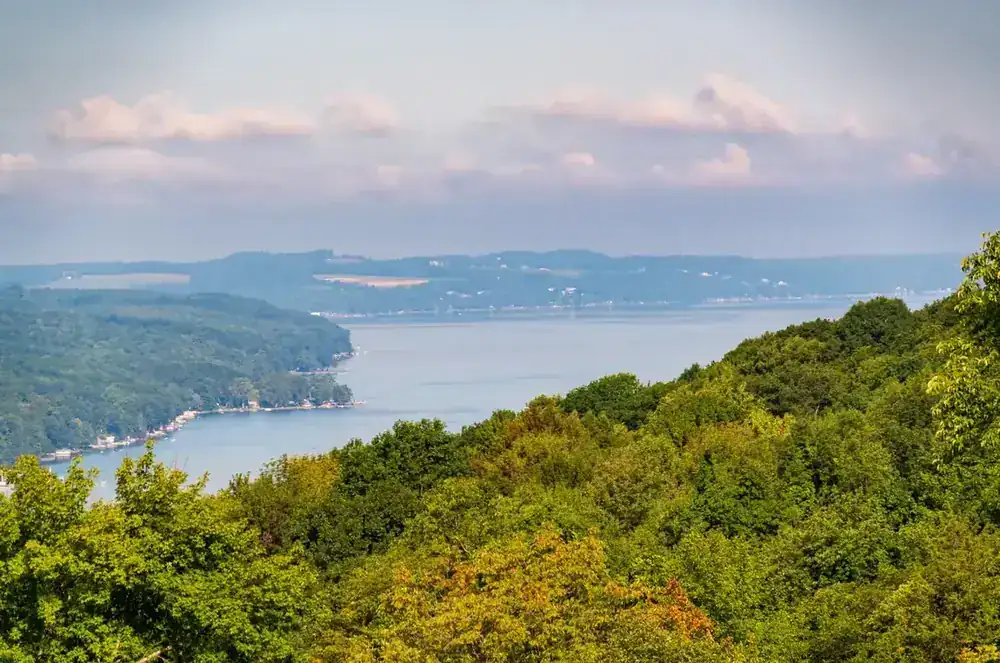
- Location
- New York
- Current protection
- Watkins Glen, Taughannock Falls, Robert H. Treman
- Status
- National heritage area bill in Congress
- In the book
- Featured in Undiscovered America
Why should it be a National Park?
The Finger Lakes region is a geographically distinct landscape in central New York state made up of 11 long, narrow lakes and the hills between them. Around two million-years-ago an ice sheet traveled south from what is now Canada and altered the terrain. Glaciers carved tremendous gorges into the ground before the ice sheet eventually receded. These gorges filled with water and became known as the Finger Lakes.
At the northern end of the lakes is a relatively flat environment between Rochester and Syracuse. In the south, the Finger Lakes overlap the northern end of the Allegheny Plateau. The lakes and mountainous topography result in an array of canyons, river gorges, and waterfalls.
Several well-known natural features populate the area, although visitors are not always aware they are part of the overall Finger Lakes region. The popular Watkins Glen State Park trail follows a stream that descends 400 feet through 200 foot cliffs, with 19 waterfalls along its course. Taughannock Falls, Robert H. Treman, and Buttermilk Falls State Parks surround the city of Ithaca. Each of these parks is incredible and worth exploring. Ithaca itself has several waterfall trails within its borders at Ithaca Falls Natural Area and the Cascadilla Gorge Trail. Waterfalls are most prominent at the southern end of the lakes.
Heading north along the shores of the lakes, many overlooks and roads provide both sweeping and up-close views of the waters. Boating, kayaking, fishing, and swimming are popular in the lakes, while many public and private reserves and parks allow for hiking and biking opportunities.
Around all of the lakes are wineries, shops, and historic sites that exemplify the diversity and cultural significance of the region. Many important historical figures once called the towns surrounding the lakes home. President Milliard Fillmore was raised in a cabin south of Owasco Lake. The Women's Rights Movement began in Seneca Falls, while human rights advocates Harriet Tubman and William Seward lived in Auburn. Many religious movements began here, including Mormonism and Spiritualism, and period structures remain to tell their stories. The Erie Canal helped bring these impactful people here in the 1800s, and the canal and sites dedicated to their legacies make this a vibrant and undeniable piece of American history.
Today, the Finger Lakes are a popular summer escape, but there is no overarching park structure to unify the natural setting and the historical elements. The intersecting trails, gorges, ravines, waterfalls, woodlands, grasslands, swamps, wildlife, and historical events are more than deserving of a National Park that assembles each of these features into one cohesive protected area.
The history of National Park Campaigns
No National Park has ever been proposed for the Finger Lakes; the region's federal footprint is a small national forest (assembled from Depression-era farm buyouts) and a national heritage area campaign that is now on its fifth Congress.
- Distinct National Park attempts
- 0
- Other designation attempts
- national forest 1982/85; NHA bills 2015, 2017, 2019, 2024, 2025 (5 Congresses)
Sources
- congress.gov S. 1288 / H.R. 2697 (119th)
- NPS Finger Lakes NHA Feasibility Study (2023, parkplanning.nps.gov/FingerLakes)
- Forest Service Museum, "Green Mountain & Finger Lakes National Forests Rangers" (Hector history)
- Green Mountain–Finger Lakes NF Land Management Plan (2006)
- 1863 / 1906
Watkins Glen opens as a private resort; becomes a state park (1906); 1920 Robert H. Treman SP; 1924 Buttermilk Falls SP; 1925 Taughannock Falls SP and Fillmore Glen SP.
- 1933–38
Federal government buys exhausted farmland between Seneca and Cayuga lakes under the Federal Emergency Relief Act; managed as the Hector Land Use Area by the Soil Conservation Service. (Forest Service Museum; traveleidoscope)
- 1938
Montezuma National Wildlife Refuge.
- 1954
Administration transferred to the U.S. Forest Service (Hector Ranger District, under Green Mountain NF); 1982 — added to the National Forest System; 1985 — Congress renames it the Finger Lakes National Forest (16,259 acres), New York's only national forest. (Wikipedia; FS Museum)
- 1980
Women's Rights NHP; 2017 — Harriet Tubman NHP.
- 2015, 2017
Sen. Kirsten Gillibrand's Finger Lakes National Heritage Area feasibility bills; 2019 — study directed by the Dingell Act (P.L. 116-9); 2023 — NPS finds the region eligible; 2024 — S. 2743 (118th).
- April 3, 2025
S. 1288, Finger Lakes National Heritage Area Act (119th Cong.), and April 7, 2025 — H.R. 2697; Senate Energy & Natural Resources Committee action recorded June 10, 2026 (VERIFY whether hearing or markup). (govinfo BILLSTATUS-119s1288)