- Location
- Georgia
- Current protection
- Ocmulgee Mounds National Historical Park, Bond Swamp National Wildlife Refuge, Ocmulgee River corridor
- Status
- Advanced to the full Senate
- In the book
- Not featured in Undiscovered America
Why should it be a National Park?
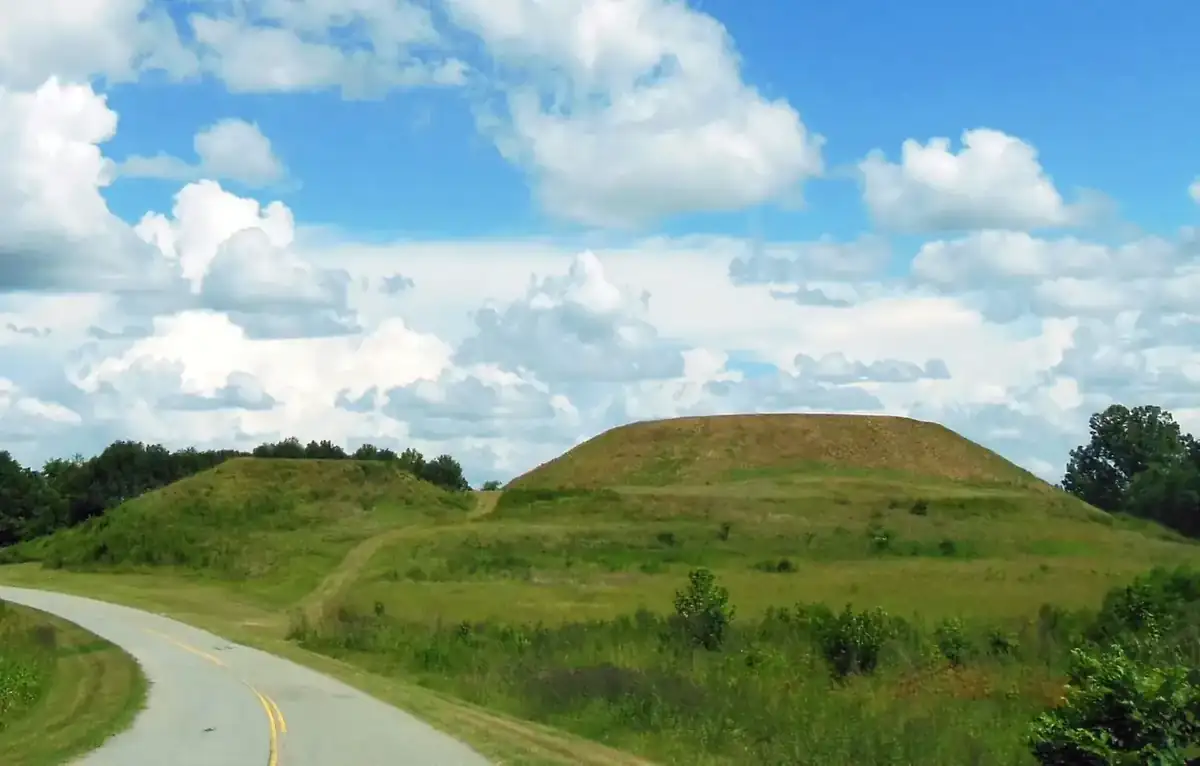
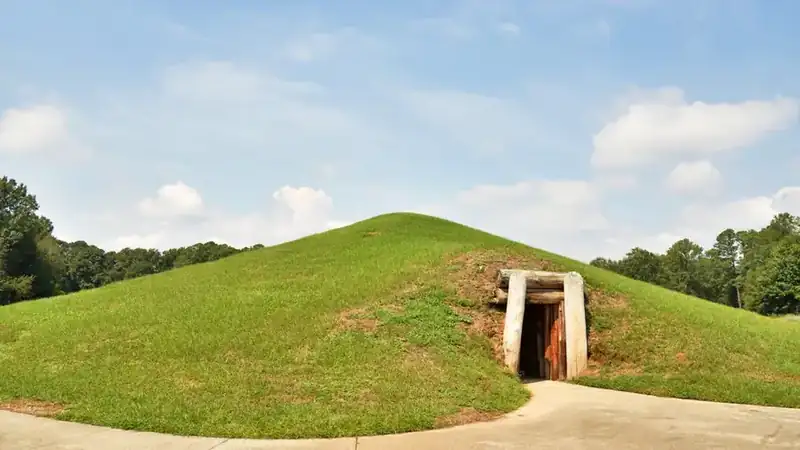
On a bluff above the Ocmulgee River at the edge of Macon stand seven earthen mounds built about a thousand years ago by Mississippian people. The Great Temple Mound rises fifty-five feet. Beneath one of them is an earth lodge with its original clay floor intact, a circular council chamber with a raised platform shaped like a bird, where the people who lived here met to decide things. Visitors sit on that floor. It was packed by hand around the year 1000.
People have occupied this site for something like seventeen thousand years, one of the longest continuous records of human presence in North America. Paleo-Indian hunters camped here. Mississippian farmers built the mounds. The Muscogee people lived here until the removals of the 1820s and 1830s drove them to Oklahoma, and the Muscogee (Creek) Nation has never stopped considering this its homeland. Today the Nation is a formal partner in the park, and the proposal to expand it was developed with them rather than around them.
The river corridor below the mounds is bottomland hardwood forest and swamp, the kind of country that survives because it floods. Black bear, alligator, and wood stork use it. Bond Swamp National Wildlife Refuge protects part of it already. A National Park Service study found the broader corridor nationally significant, and the proposed boundary would knit the mounds, the swamp, and the river into a single unit.
The bill would make this Georgia's first National Park, a National Park and preserve, with hunting continuing in the preserve portion. It has something almost no other park proposal in the country has: the entire state congressional delegation, both parties, and the tribal nation whose ancestors built the place, all pulling the same direction. It cleared a Senate committee in July 2026. If it passes, it will be the first National Park in America established in partnership with the people who were removed from it.
The history of National Park Campaigns
Ocmulgee would become Georgia's first National Park, a National Park and preserve incorporating the existing national historical park, Bond Swamp National Wildlife Refuge, and Ocmulgee River corridor lands, developed with the Muscogee (Creek) Nation. Bills in the 118th and 119th Congresses have had unified Georgia delegation support; S. 1131 advanced out of Senate Energy and Natural Resources to the full Senate on July 1, 2026.
- Distinct National Park attempts
- 3 (1933–34 park vision; 2024; 2025–26)
- Other designation attempts
- 4 (monument 1934; historical park redesignation and expansion 2019; corridor study; traditional cultural property listing 1997)
Sources
- NPS Ocmulgee River Corridor Special Resource Study
- Senate Report 114-318 and Proclamation 2212
- congress.gov, S. 1131 and H.R. 2345 (119th Congress)
- NPCA, Economic Analysis of the Proposed Ocmulgee National Park and Preserve
- 1933–1941
Civil Works Administration and WPA excavations under Arthur Kelly, among the largest archaeological digs in American history.
- June 14, 1934
Congress authorizes Ocmulgee National Monument, envisioning roughly 2,000 acres; Depression-era Macon can finance only about 678.
- December 23, 1936
President Roosevelt proclaims the monument (Proclamation 2212).
- 2016
S. 1696 to redesignate the monument a national historical park and revise the boundary; passes the House by voice vote, not completed in the Senate.
- March 12, 2019
Enacted in the Dingell Act (P.L. 116-9): redesignation to Ocmulgee Mounds National Historical Park, boundary expansion toward 3,336 acres, and authorization of a special resource study of the river corridor.
- 2019–2021
The NPS Ocmulgee River Corridor Special Resource Study finds the broader corridor nationally significant.
- May 1, 2024
S. 4216 and H.R. 8182, the Ocmulgee Mounds National Park and Preserve Establishment Act; reported by Senate ENR November 21, 2024, but dies when the year-end public lands package fails.
- March 25, 2025
Reintroduced as S. 1131 (Ossoff and Warnock) and H.R. 2345 (Austin Scott, with the Georgia delegation).
- December 9, 2025
Senate ENR National Parks Subcommittee hearing.
- June 24, 2026
Rep. Scott introduces H.R. 9416, a streamlined name-only redesignation, with 11 Georgia cosponsors.
- July 1, 2026
Senate ENR advances S. 1131 to the full Senate; a House subcommittee hearing on the redesignation bill is held the same day.