- Location
- Oregon
- Current protection
- John Day Fossil Beds National Monument, Painted Hills Reservoir, John Day River
- Status
- No active campaign
- In the book
- Featured in Undiscovered America
Why should it be a National Park?
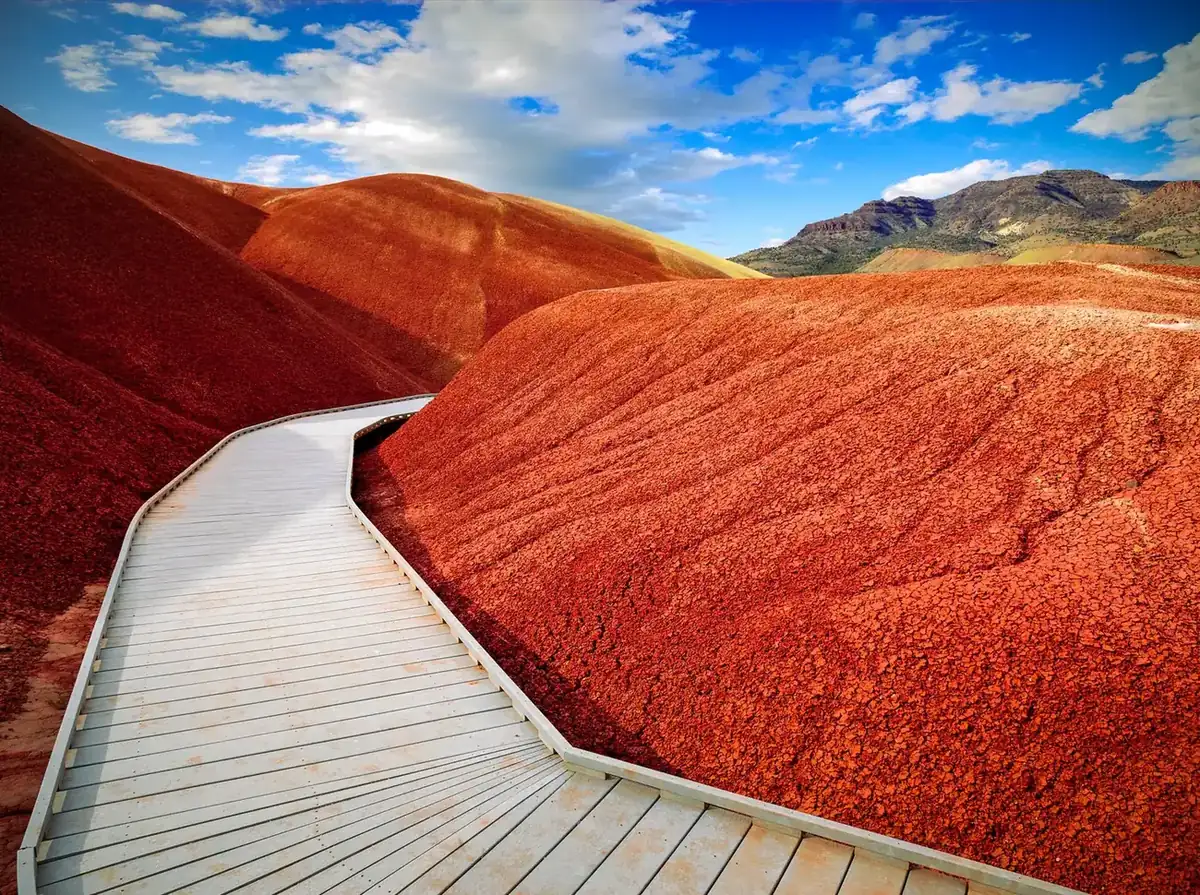
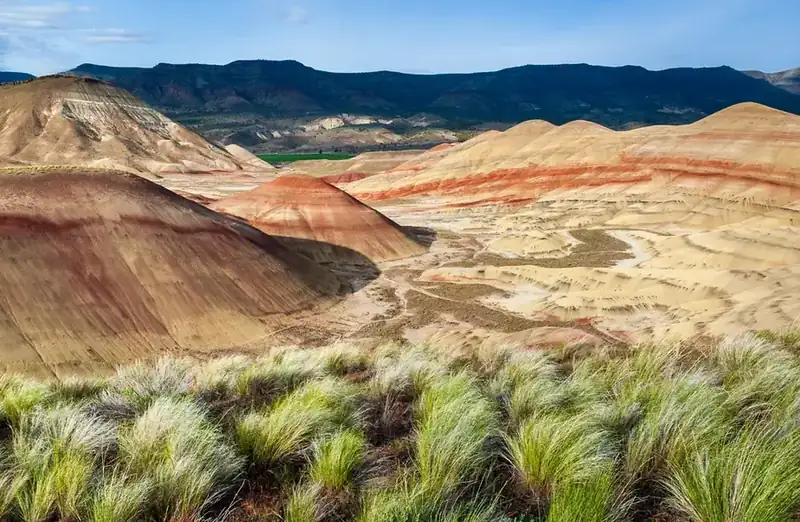
The little-known John Day Basin in central Oregon's high desert contains some of the world's most alien-looking landscapes, with colorful hills that extend for hundreds of miles. This rainbow landscape is scattered across a region of five-million-acres with immense visual and geologic importance, yet only 14,000 acres of it are protected as part of John Day Fossil Beds National Monument. Instead of celebrating and protecting this vast and unique painted desert, most of the lands surrounding the John Day basin are ranches, farms, and sites of natural resource extraction which are forever altering this missing icon of the American landscape.
The focal point of this region are the spectacular Painted Hills. Unlike the red sandstone of the Southwest, which actually displays shades of orange and yellow, the red pigments found here result from the volcanic ash found in the lowest level of the John Day Strata or rock layer, dating from 33-million-years-ago.
The well-defined stratification layers seen throughout the area are typically only seen in cliffs and canyons. But these hills have been worn smooth by an ancient river that deposited mudstone, siltstone, shale, and laterite over several geographical eras. Each vibrantly colored ancient layer gives a surreal contrast to the basin's modern species of sagebrush, grasses, and juniper. As the geologic layers solidified into these hued mounds, they buried the remains of prehistoric horses, camels, and other large animals that originated in the Americas. Sadly, after spreading to other continents by a land bridge, these animals died out in the Americas before humans arrived.
In addition to the colorful soils, occasional peaks of volcanic basalt break free from the shrubland habitat. These dark rocks tear their way through the vegetation and stand as a testament to a geologic history that has been largely ignored. The basin has gone through extensive physical changes and these outcroppings give insight into the evolution of climate, species, and volcanic activity. The fossils of over 170 species have been found in these rocks.
Depending on the time of year, the plant life can be just as colorful and surprising as the painted desert. Many prairie environments alternate between yellow and green grasses, depending on weather, but with the right conditions, large fields of red grasses stretch out across the plains. These grasses are actually the result of an invasive species, but there is no denying their visual splendor. Color shifts are most prominent in late spring and autumn, but can also occur during times of scarce rainfall.
The Painted Hills are perhaps the most visually alluring place in the country that flies under our collective radar. If more people knew about and experienced the natural splendor found beyond the cascade mountains, there would be no doubt that this exemplary desert environment would be better protected and admired.
The history of National Park Campaigns
The fossil beds were protected first as Oregon state parks (1930s) and then as John Day Fossil Beds National Monument (authorized 1974, established 1975); no National Park has been proposed. The adjacent Sutton Mountain has been the subject of wilderness and monument proposals (2021–2024), and NPCA launched a Greater Painted Hills Collaborative in 2025.
- Distinct National Park attempts
- 0
- Other designation attempts
- state parks 1930s; monument 1974–75; wilderness/monument proposals 2021–24
Sources
- NPS John Day Fossil Beds administrative history (npshistory.com/publications/joda)
- P.L. 93-486 legislative history
- Merkley press releases
- 1930s
Oregon acquires Painted Hills, Clarno, and Thomas Condon–John Day state parks.
- 1960s–1974
NPS studies; October 26, 1974 — P.L. 93-486 authorizes John Day Fossil Beds NM (Sens. Hatfield/Packwood; Rep. Ullman); established 1975 with the state parks transferred.
- 2005
Thomas Condon Paleontology Center opens.
- 2021–2024
Sutton Mountain and Painted Hills Preservation and Economic Enhancement Act (Sens. Merkley/Wyden) — wilderness plus economic provisions; 2024 — calls for a Sutton Mountain national monument; not acted on.
- 2025
NPCA Greater Painted Hills Collaborative.