- Location
- Nevada
- Current protection
- Red Rock Canyon National Conservation Area, La Madre Mountains Wilderness, Rainbow Mountain Wilderness
- Status
- No park campaign on record
- In the book
- Not featured in Undiscovered America
Why should it be a National Park?
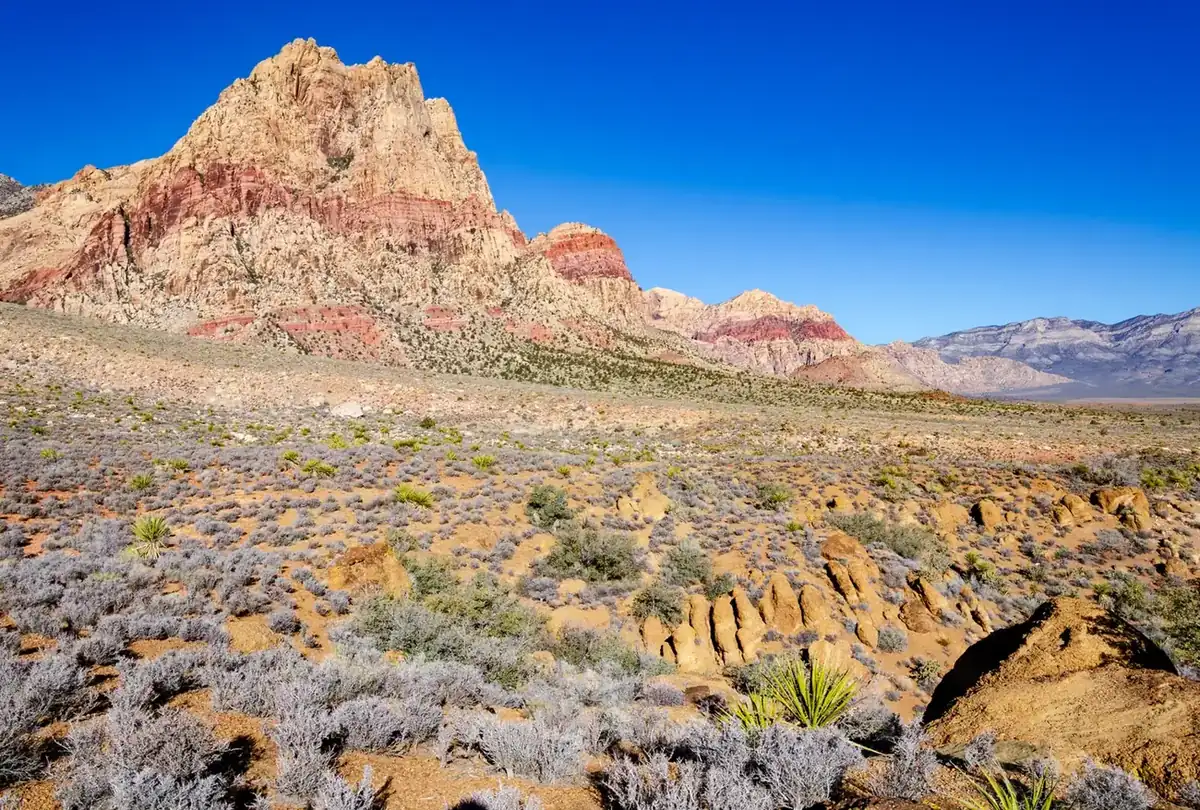
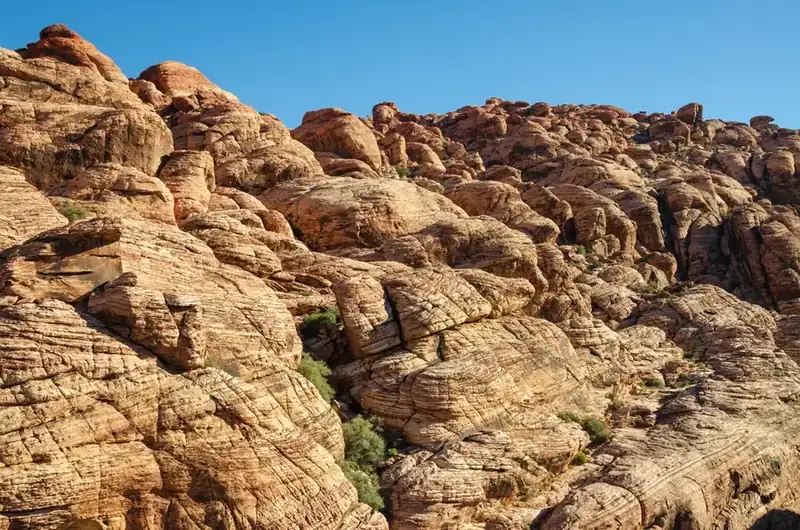
Seventeen miles west of the Las Vegas Strip, the desert stands up. The Keystone Thrust runs along the front of the Spring Mountains here, a fault where gray limestone was shoved up and over red Aztec sandstone about sixty-five million years ago, which is why the escarpment has a red bottom and a gray top and looks, from the valley floor, like it was assembled backward. The sandstone is petrified sand dunes, and the cross-bedding in the cliffs is the record of wind that blew across this place in the Jurassic.
The scale is easy to miss from the casinos. The escarpment rises three thousand feet. Canyons cut back into it — Pine Creek, Icebox, First Creek, Oak Creek — and several hold water year-round, which in the Mojave is the difference between a canyon and a refuge. Bighorn sheep work the cliffs. Wild burros, descendants of prospectors' stock, graze the flats. The rock climbing here is world famous, thousands of routes on sandstone that draws people from everywhere.
The Southern Paiute lived in these canyons and their agave roasting pits and rock art are still in them. The Spring Mountain Ranch at the south end was a working spread that passed through a chain of owners including Howard Hughes.
Red Rock has never been proposed as a National Park. Monument and recreation area ideas circulated in the 1960s and the Park Service declined them. The BLM made it a recreation lands unit in 1967 and Congress made it Nevada's first national conservation area in 1990, expanding it to roughly 195,000 acres four years later. It now takes in something like three million visitors a year on a thirteen-mile scenic loop, which is more than most National Parks, under a designation almost nobody outside Nevada can define.
The visitation numbers are the argument nobody makes out loud. Red Rock draws around three million people a year, more than most National Parks receive, on thirteen miles of one-way scenic drive that now runs on timed entry because the road could not absorb the crowds. It does this with a BLM budget, which is a fraction of what an equivalent Park Service unit would get.
It is also one of the great climbing areas in the country. The Aztec Sandstone takes protection well and holds routes a thousand feet and longer, and on a spring weekend the lots fill with climbers from everywhere. Any park designation here would have to be written to keep that access intact, which is not a novel problem: Joshua Tree, Zion, and Yosemite are all National Parks and all world climbing destinations, and the Park Service has spent decades learning how to manage them.
The real threat here has never been from visitors. It has been from the ridge above the canyon, where a gypsum mine and then a housing development were proposed on Blue Diamond Hill, and where Las Vegas keeps arriving at the boundary. The conservation area exists because the county and the state fought for a line, and the argument for a stronger designation is mostly an argument about how permanent that line should be.
The history of National Park Campaigns
Red Rock Canyon National Conservation Area was established November 16, 1990, Nevada's first national conservation area, and expanded in 1994 to roughly 195,610 acres. It is BLM-managed. In the 1960s recreation area and monument ideas circulated but the NPS declined. No National Park or monument bill has been identified, and the area belongs on the misattribution list for park-campaign purposes.
- Distinct National Park attempts
- 0
- Other designation attempts
- 3 (recreation lands 1967; conservation area 1990; expansion 1994)
Sources
- P.L. 101-621 and 16 U.S.C. subchapter 114
- BLM Red Rock Canyon NCA resource management plan
- UNLV Special Collections, Red Rock Canyon records
- 1967
Red Rock Canyon Recreation Lands established by the BLM.
- 1960s
Recreation area and monument ideas circulate; the NPS declines.
- November 16, 1990
Red Rock Canyon National Conservation Area established (P.L. 101-621), Nevada's first.
- 1994
Expanded to roughly 195,610 acres.
- Present
BLM-managed; no National Park bill on record.