- Location
- Oklahoma
- Current protection
- Wichita Mountains National Wildlife Refuge, Quartz Mountain Nature Park
- Status
- No active campaign
- In the book
- Featured in Undiscovered America
Why should it be a National Park?
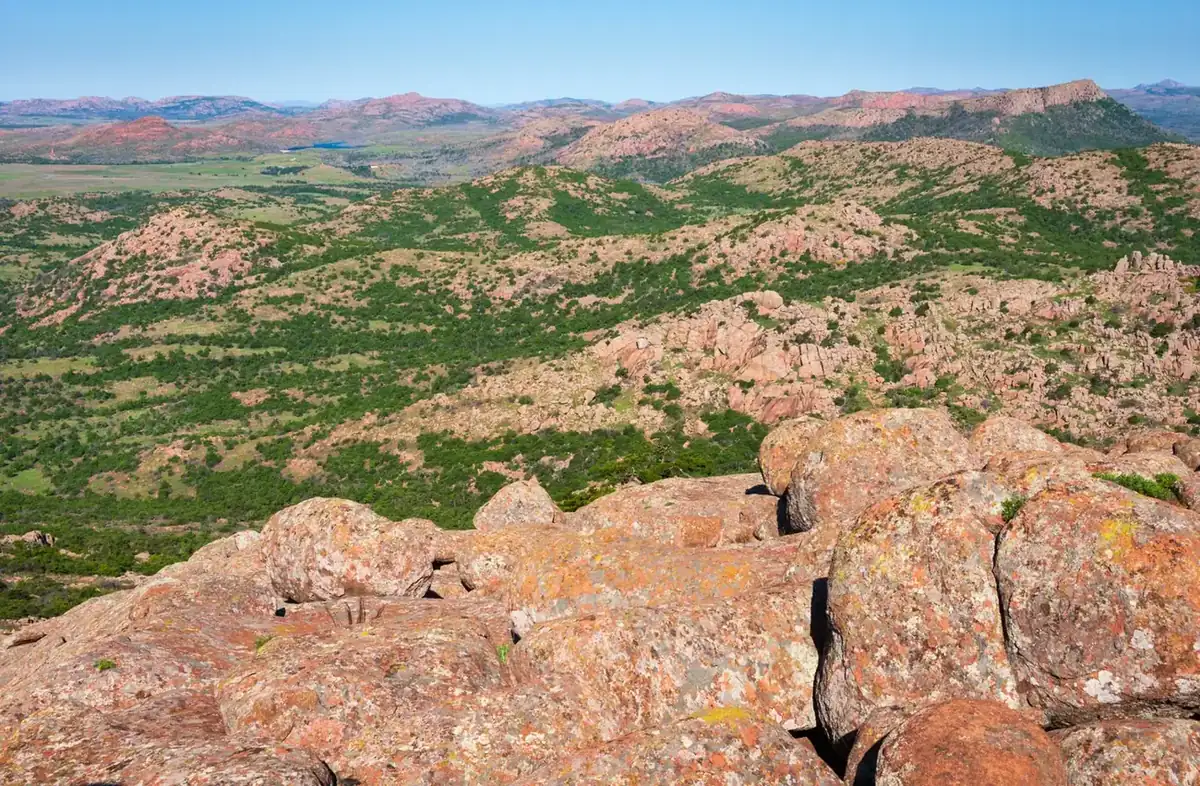
In southwestern Oklahoma lies the Wichita Mountains, an environment of boulder covered buttes and calm blue lakes that is at odds with the rest of the great plains. The range was initially formed by magmatism, followed by shifting climates and tectonic collisions that first buried the now exposed rocks. Uplift brought the rocks back to their current prominence above the plains, where the exposed boulders and slopes were sculpted by erosion.
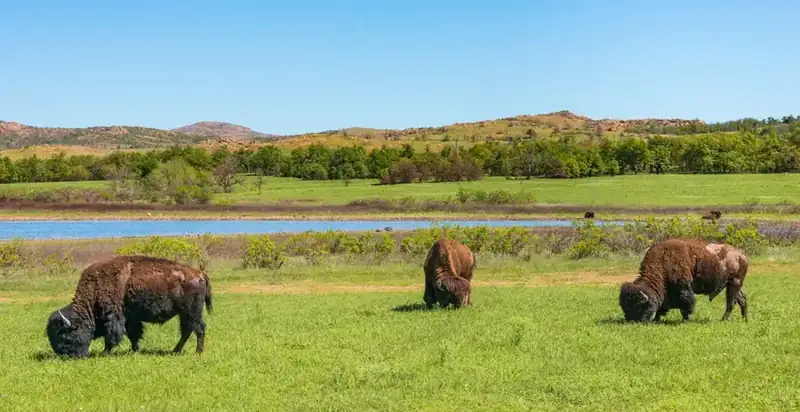
In 1901, the central sections of the range were placed in the stewardship of the U.S. Fish and Wildlife Service as a wildlife refuge. The refuge protects over 50 mammal, 240 bird, 64 reptile and amphibian, 36 fish, and 806 plant species that inhabit the native grazing lands of Oklahoma. While protecting the local flora and fauna is admirable, the designation as a wildlife refuge has resulted in the Wichita Mountains being left by the wayside of history.
Despite the unique features in this mountain range, which more closely resemble Sub-Saharan Africa than anywhere in the western hemisphere, these rugged mountains are unknown to most Americans. This lack of notoriety has resulted in limited protection for the mountains, with only half of the nearly 60,000 acres currently under any form of federal or state jurisdiction.
Currently, there are no National Parks that primarily focus on the grasslands and prairie, an environment that makes up roughly one-third of the contiguous USA. A few western parks contain some prairie lands, but none of them can compare to the volume of grassland found in the great plains. The Wichita Mountains could be the centerpiece for finally creating a park focusing on the plains and their massive scale. At the very least, the creation of a Wichita Mountains National Park could fill the 700 mile void between the closest eastern and western parks.
Nearby sections of the range like the Quartz Mountain Nature Park even have a National Park history with trails, roads, and a lodge built by the Civilian Conservation Corps in the 1930s. Mount Pinchot, the tallest mountain in the range, is located outside of public access in a 'special use area' where scientific research takes place. By limiting the refuge boundary, the Wichita Mountains have effectively been split into private and public enclaves. The public lands protect the natural setting originally found throughout the region, while the private areas contain towns, stores, religious retreats, and farms that have filled in the open patches between stone peaks.
Preserving the Wichita Mountains, in its native and uninterrupted form, would create a prime example of the sporadic but exemplary natural environments found in this overlooked region. Landscapes like these, which demonstrate the physical and scenic diversity of the United States, are the reason National Parks were established.
A brief attempt at creating a 'Wichita Mountains National Park' was made with H. R. 13190 in 1929, but the legislation was unsuccessful.
The history of National Park Campaigns
The Oklahoma City Commercial Club "campaigned locally and nationally" for a National Park in the early 1900s; the result was the Wichita Forest Reserve (July 4, 1901) and, after the Act of January 24, 1905, Roosevelt's June 2, 1905 proclamation of the Wichita Forest and Game Preserve, the nation's first federal big-game refuge (bison from the New York Zoological Society, 1907). Congress made it the Wichita Mountains Wildlife Refuge on June 4, 1936. The book's 1929 park bill (H.R. 13190) has not been confirmed in three passes.
- Distinct National Park attempts
- 1 (early-1900s movement) + 1 unverified (1929 bill)
- Other designation attempts
- forest reserve 1901; game preserve 1905; refuge 1936; wilderness 1970
Sources
- Oklahoma Historical Society, Encyclopedia of Oklahoma History and Culture, "Wichita Mountains National Wildlife Refuge"
- NARA Fort Worth RG 22 finding aid
- proclamations 459, 563, 2211
- Act of June 4, 1936
- Early 1900s
Oklahoma City Commercial Club campaign for a National Park; "a regional movement to protect the shrinking bison population and to gain a National Park for the imminent state." (Oklahoma Historical Society encyclopedia)
- July 4, 1901
McKinley's Proclamation 459: Wichita Forest Reserve (~59,000 acres) within the Kiowa-Comanche-Apache reservation lands.
- January 24, 1905
Act "for the protection of wild animals and birds in the Wichita Forest Reserve" (33 Stat. 614); June 2, 1905 — Roosevelt's Proclamation 563 designates the entire reserve a game preserve. (presidency.ucsb.edu)
- 1907
Fifteen bison arrive from the Bronx Zoo (William Hornaday/American Bison Society); 1906/1910 — boundary changes.
- 1929
"H.R. 13190, Wichita Mountains National Park" (per the book) — UNVERIFIED after three research passes; seek in the 70th–71st Congress Record Index.
- 1935
Transferred to the Bureau of Biological Survey (EO 7116, July 26, 1935); June 4, 1936 — Act (49 Stat. 1446) names it the Wichita Mountains Wildlife Refuge; November 27, 1936 — Proclamation 2211 abolishes the Wichita National Forest. (16 U.S.C. §684 notes)
- 1970
Charons Garden and North Mountain Wildernesses (P.L. 91-504).
- 1994–2021
Quartz Mountain: state park (1937) → OU "Nature Park" (2001) → back to Oklahoma Tourism (~2021).