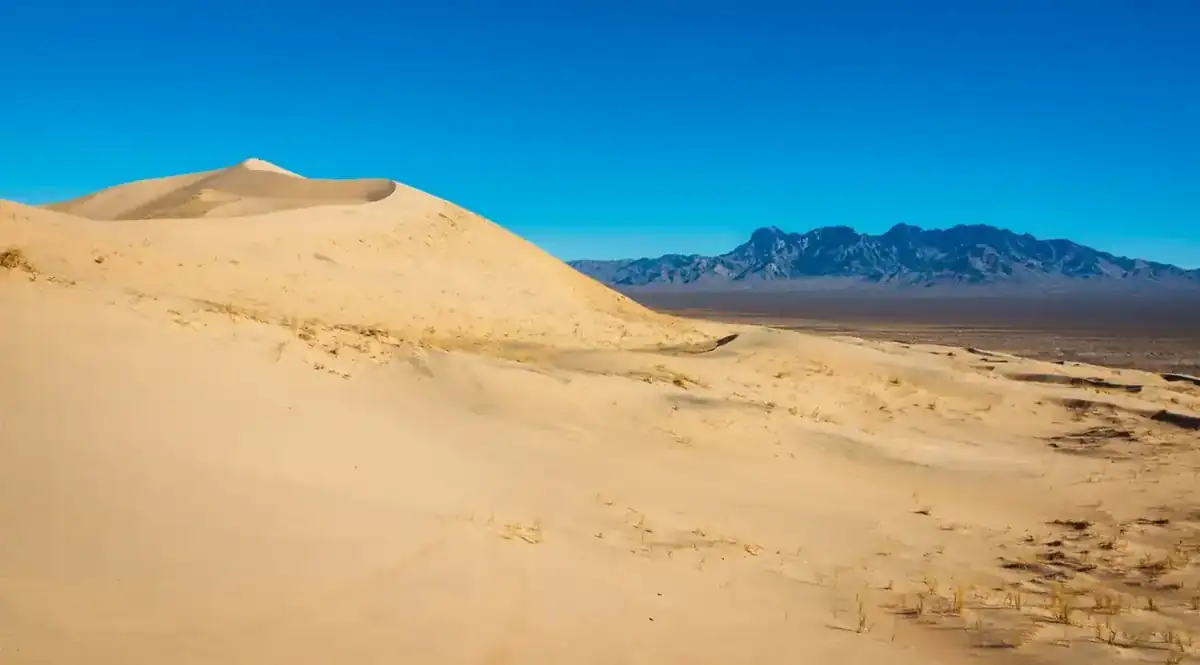
- Location
- California
- Current protection
- Mojave National Preserve, Providence Mountains/Mitchell Caverns
- Status
- Boundary bill in Congress
- In the book
- Featured in Undiscovered America
Why should it be a National Park?
Three of the four major North American deserts meet at Mojave National Preserve: the Mojave, Great Basin, and Sonoran. This intersection of ecosystems creates an ever-changing landscape of rock formations, sand dunes, Joshua tree forests, mountain ranges, dry river beds, great mesas, cinders cones, and lava flows. Ancient rocks in the Clark Mountains date back an impressive 2.5 billion years.
The Mojave Desert has a vibrant history. Before contact with the Europeans, native peoples lived on prickly pear, mesquite, and roasted agave blooms, and hunted deer and bighorn sheep. When explorer Father Francis Garces traveled across the Mojave Desert, in 1776, he was met by members of the Mojave Tribe. Other intrepid explorers would follow, including Jedediah Smith in 1826 and John Fremont in 1844. Settlers flooded west and during the 1860s and government outposts were established, providing protection for wagons.
In this same era, gold fever struck California. The General Mining Law of 1872 permitted individuals to stake a claim on an area of land where a mineral deposit was discovered. Copper, iron, gold, and silver mines rapidly became established in the Mojave. In 1883, on the eastern side of the Providence Mountains, silver was discovered in the Bonanza King Mine. The ruins of these mines still exist and can be visited today.
Much of Mojave appears to be barren, nearly lifeless. Signs of animal life are subtle and easily missed. Birds and lizards are seen most frequently, but the time of day, weather, and season all play a role in determining which animals are active. They are supremely adapted to manage the temperature and moisture stresses. A large percentage of desert animals are nocturnal, allowing them to evade higher daytime temperatures and predators. Nocturnal animals include most desert rodents, bats, owls, mountain lions, skunks, and foxes.
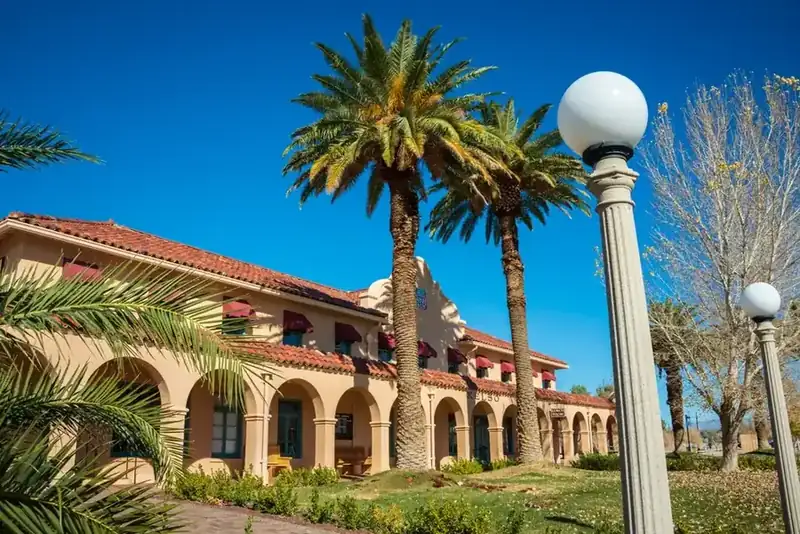
At the heart of the preserve is the Kelso Depot, which once provided food, recreation, and accommodations for Union Pacific Railroad employees, but is now the principal visitor center. Surrounding the visitor center is the picturesque ghost town of Kelso, which provides a stark look into the history of the region.
Mojave National Preserve is a wonderful place to explore and learn about geology. Trails and backcountry abound for those looking to experience the desert without the crowds at Death Valley and Joshua Tree National Park to the northwest and south, respectively.
Located between Los Angeles and Las Vegas, Mojave provides serenity and solitude from major metropolitan areas. It is an isolated and often overlooked section of Southern California, but don't be mistaken, it's one of the most incredible natural and historic areas in a state that boasts so many incredible sites. The intersection of ecosystems makes it feel like a greatest hits compilation of all the region offers.
The history of National Park Campaigns
The East Mojave was proposed as a National Park — "Mojave National Park" — in the Sierra Club-led California Desert Protection League's maps of 1984 and in Sen. Alan Cranston's California Desert Protection Act, first introduced in 1986 and reintroduced through 1991; Sen. Dianne Feinstein carried it to passage in 1994, by which time Rep. Jerry Lewis had forced the downgrade to a national preserve to keep hunting and grazing. The BLM's 1981 East Mojave National Scenic Area had itself been created "to placate those environmentalists who wished to turn the area into a National Park." Lewis then tried to kill the preserve with a $1 appropriation in 1995–96.
- Distinct National Park attempts
- 1 sustained campaign, 4 Congresses (1986, 1987, 1989, 1991) + 1993–94 — "Mojave National Park" in every CDPA draft until the 1994 preserve amendment
- Other designation attempts
- scenic area 1981; preserve 1994; monuments 2016; boundary bill 2024
Sources
- Eric Charles Nystrom, From Neglected Space to Protected Place: An Administrative History of Mojave National Preserve (NPS, 2003)
- CDPA legislative history (S. 21, 103rd Cong
- H. Rept. 103-832)
- Frank Wheat, California Desert Miracle: The Fight for Desert Parks and Wilderness (1999)
- 1970–1976
Sen. Charles Mathias's desert bill (1970), Cranston's versions (1971, 1973, 1974 hearing) folded into FLPMA §601 (Oct. 21, 1976): the California Desert Conservation Area; 1980 Desert Plan.
- January 13, 1981
BLM designates the East Mojave National Scenic Area (46 FR 3994), "the first designation of its kind, which was intended to placate those environmentalists who wished to turn the area into a National Park, while also permitting... ranching and mining."
- 1982–84
BLM plan amendments alarm conservationists; by 1984 the California Desert Protection League (Sierra Club-led) drafts maps and legislation to expand Death Valley and Joshua Tree to National Parks, "create a third so-called Mojave National Park out of the East Mojave National Scenic Area," and designate dozens of BLM wilderness areas.
- 1986
CRANSTON INTRODUCES THE CDPA (99th Cong.); reintroduced in the 100th (1987), 101st (1989), and 102nd (1991) Congresses; blocked in the Senate by Republican colleagues Pete Wilson, then John Seymour; the House passed the bill in 1991 (Rep. Mel Levine's version). VERIFY bill numbers (S. 2061? S. 7? S. 11? S. 21; H.R. 2929).
- 1992–93
Feinstein wins the seat and makes the CDPA (S. 21, 103rd Cong.) her top priority.
- 1994
Rep. Jerry Lewis (R-Redlands) "was instrumental in changing the CDPA to reduce the status of Mojave from a 'park' to a 'preserve'"; Congress passes the act October 8; October 31, 1994 — Clinton signs P.L. 103-433: Mojave National Preserve (~1.42–1.6M acres), hunting/grazing retained, the scenic area abolished (16 U.S.C. §410aaa-45).
- 1995–96
Lewis's "Dollar Budget" ($1 appropriation) attempts to return the preserve to BLM; Clinton veto threat; final FY1996 deal $1.1M NPS + $500K planning.
- 2016
Castle Mountains NM and Mojave Trails NM (Obama, Feb. 12, 2016); 2024 — Sen. Padilla's Mojave National Preserve Boundary Adjustment Act to absorb Castle Mountains; 2025 — BLM/Dateline Resources mining controversy (Padilla letter).