- Location
- Arizona
- Current protection
- Chiricahua National Monument, Fort Bowie National Historic Site, Coronado National Forest
- Status
- Passed the House; awaiting a Senate vote
- In the book
- Featured in Undiscovered America
Why should it be a National Park?
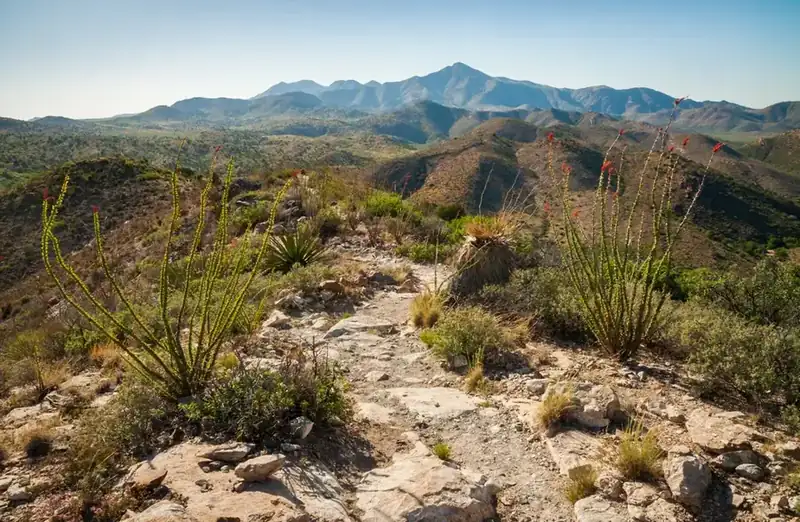
The Chiricahua Mountains in southeastern Arizona are considered a "sky island" ecosystem: a mountain range where the terrain, plants, and wildlife are significantly different from the landscape that surrounds them. Southern Arizona is characterized by an arid desert with few plants other than cacti and brush, but the Chiricahua Mountains that rise out of the Chihuahuan Desert allow for a higher concentration of species and greenery.
Covering an area 40 miles north to south and 20 miles wide, the range is the centerpiece of the North American Cordillera, which serves as the continent's geologic backbone, extending 4,000 miles from Alaska to southern Mexico. Contained almost entirely within public lands, the Chiricahua Mountains are divided into Fort Bowie National Historic Site, Chiricahua National Monument, and Coronado National Forest.
As settlers began spreading west during the mid-1800s, a path was established through the mountains. This path became known as Apache Pass, named for the native tribe who inhabited the mountains. This increase in travelers led to Apache raids and attacks. The U.S. Army constructed Fort Bowie to protect the settlers. The fort was in use from 1862 to 1894, but in the years following its closure, the adobe structure saw significant decay. In 1972, it was protected as a National Historic Site.
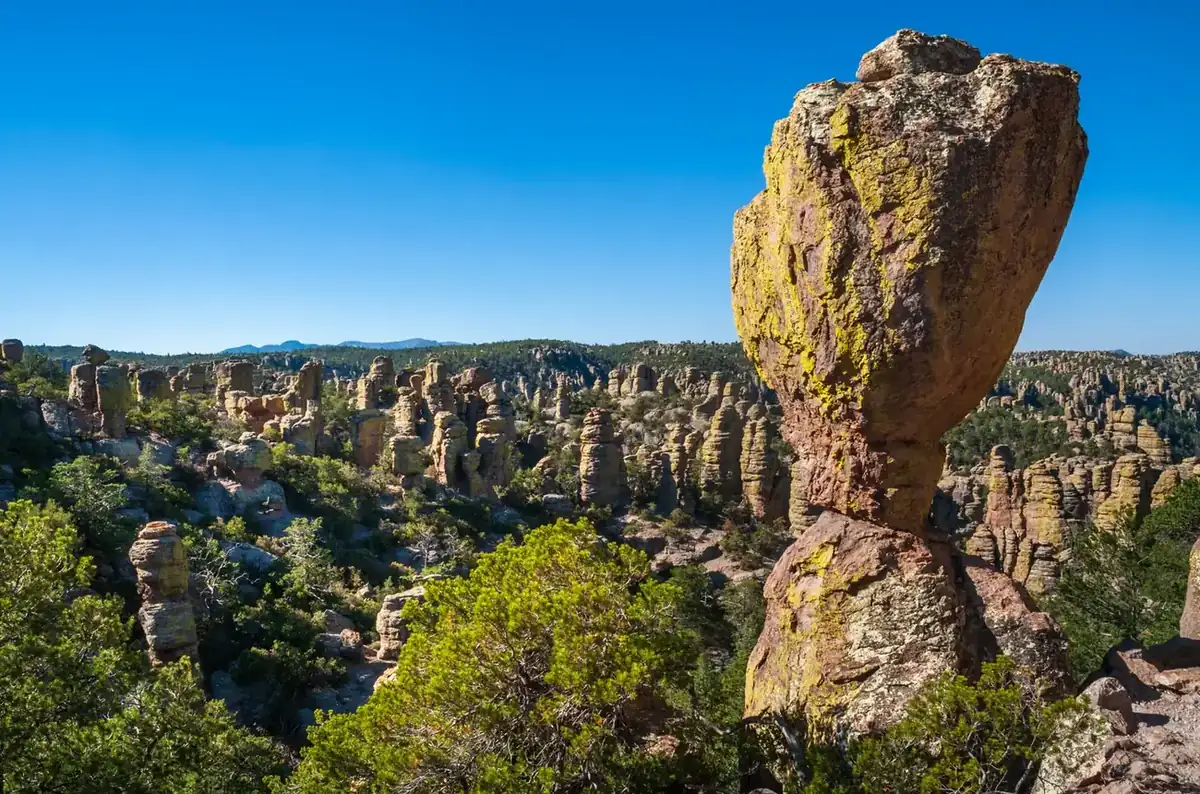
The majestic Chiricahua National Monument in the northwest of the mountains is home to rock formations known as hoodoos These tall, thin spires of rock protrude from a high elevation forest. A strange yellow moss accents these car-sized towers, creating an environment like nowhere else in the country. Perhaps the most impressive thing about Chiricahua is how it has remained a hidden gem instead of a popular tourist attraction. These formations are located less than 15 miles from Fort Bowie, but the noticeable differences in terrain are a defining feature of the mountains. Plants and natural features vary greatly depending on elevation within the mountain range.
Despite the protection of the Fort Bowie National Historic site and Chiricahua National Monument under the NPS, over 90 percent of the Chiricahua Mountains are designated as the Coronado National Forest, which allows for mineral extraction. This one-of-a-kind range and its unique features could be irrevocably altered.
In 2016 Martha McSally, at the time Arizona's 2nd Congressional Representative, introduced legislation redesignating Chiricahua National Monument as a National Park. While this would be a substantial first step, the proposal should be widened to include the entire Chiricahua mountain range and Fort Bowie. Only then will the interconnected stories of the Apaches, westward expansion, and a rich geologic history be elevated to their rightful place in the American narrative, along with ensuring these lands are not destroyed through mineral exploitation.
In 2016, Congresswoman Martha McSally introduced a bill to redesignate Chiricahua National Monument as a National Park, but the effort failed.
The history of National Park Campaigns
Chiricahua's park bid is the most persistent live effort on the list: a 2016 House bill (McSally), a 2020 Senate bill (McSally, S. 3121), Sen. Mark Kelly's S. 1320 (passed the Senate unanimously March 31, 2022), Rep. Ciscomani's H.R. 1479 (2023), and the current H.R. 6380 / S. 3715, which passed the House March 16, 2026 and cleared the Senate Energy and Natural Resources Committee July 29, 2026. Ed Riggs and the Faraway Ranch family had lobbied for the original monument in the early 1920s, hoping for a park.
Where the bill stands
H.R. 6380 and S. 3715
- IntroducedH.R. 6380, December 3, 2025
- Passed the HouseMarch 16, 2026
- Senate committeeApproved S. 3715, July 29, 2026
- Vote in the full SenateWaiting
- Signed into lawNot yet
Checked September 20, 2026
- Distinct National Park attempts
- 5 bills across 5 Congresses (2016; 2020; 2021–22; 2023–24; 2025–26)
- Other designation attempts
- monument 1924/1938; wilderness 1976
Sources
- S. Rept. 117-88
- DOI testimony on S. 3121, S. 1320, H.R. 1479
- H. Rept. 119-543
- Wegman-French, Faraway Ranch Special History Study (NPS, 2006)
- Chiricahua NM administrative history (VERIFY availability)
- 1886–1923
Neil and Emma Erickson homestead Bonita Canyon (Faraway Ranch); their daughter Lillian and husband Ed Riggs run a guest ranch and promote the "Wonderland of Rocks" "as a tourist attraction and potential national monument," with "strong financial motivations for wanting the monument created." (NPS, Faraway Ranch; Wegman-French, Faraway Ranch Special History Study, 2006)
- April 18, 1924
Coolidge's Proclamation 1692 creates Chiricahua National Monument; 1938 — Proclamation 2288 expands it; 1934 — CCC camp at Bonita Canyon builds trails and roads.
- 1976
Chiricahua National Monument Wilderness (~85% of the monument).
- 1979
NPS buys Faraway Ranch (Historic District).
- 2016
Rep. Martha McSally (R-AZ) introduces a bill to redesignate the monument as Chiricahua National Park (VERIFY H.R. number).
- 2019–2020
Sen. McSally's S. 3121 (116th Cong.); DOI testimony supports redesignation as "consistent with the nomenclature patterns of the National Park System." (doi.gov/ocl/s-3121)
- April 2021
Sen. Mark Kelly (D-AZ) introduces S. 1320 (co-sponsor Sinema; House companion by Rep. Ann Kirkpatrick, 2022); Senate ENR reports it (S. Rept. 117-88); March 31, 2022 — passes the Senate by unanimous consent; dies in the House. (congress.gov; govtrack; Kelly release)
- 2023–2024
Rep. Juan Ciscomani (R-AZ) introduces H.R. 1479; House subcommittee hearing (Chair Tiffany) with NPS testimony in support; Kelly's Senate bill clears committee; no final passage. (doi.gov/ocl/hr-1479; Cronkite News, May 24, 2023)
- December 3, 2025
Ciscomani's H.R. 6380; reported March 12, 2026 (H. Rept. 119-543); March 16, 2026 — passes the House by voice vote under suspension; Senate refers to ENR March 17. January 28, 2026 — Kelly's S. 3715 (with Sen. Ruben Gallego); July 29, 2026 — ENR orders it reported; CBO cost estimate August 18, 2026 (\<$500,000). Would make Chiricahua the first new National Park since New River Gorge (2020) and Arizona's fourth. (congress.gov; cbo.gov/publication/62700)